
SGPA to Percentage: Formula for Every Major University (With Examples)
Placement forms, scholarships and higher-studies applications often ask for a percentage, but your marksheet shows an SGPA. The correct conversion depends on your university. Here are the formulas the major universities publish, worked examples, and how SGPA turns into CGPA.
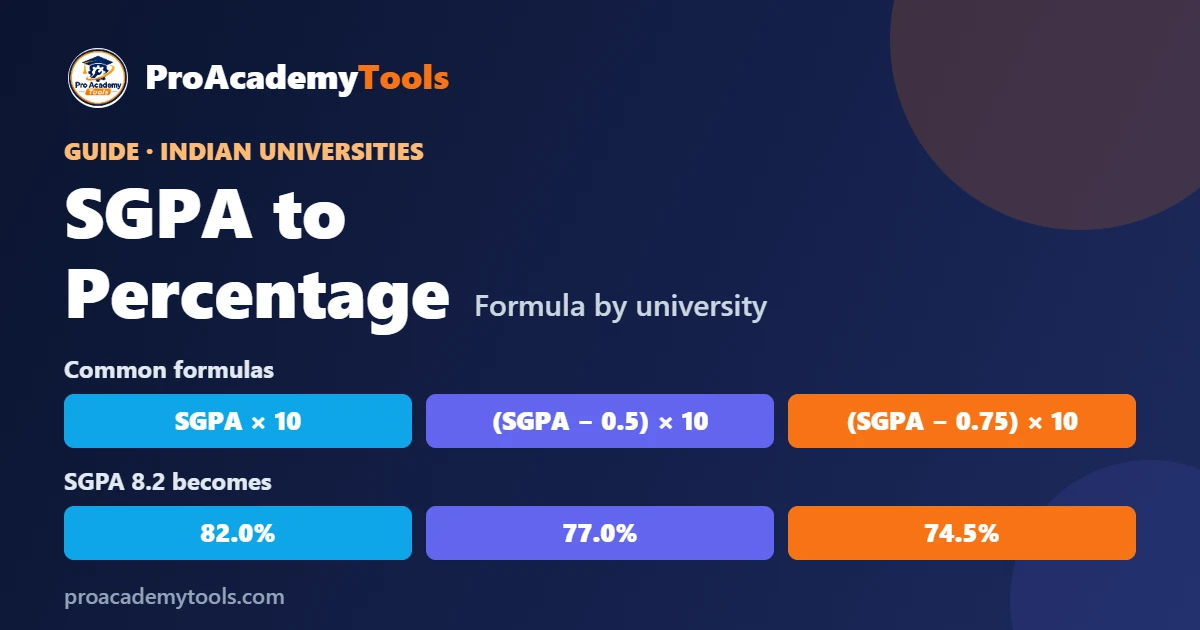
The most common rule is Percentage = SGPA × 10 — an SGPA of 8.2 becomes 82%. But many universities publish their own formula: (SGPA − 0.5) × 10 at KTU, JNTUH and GTU (8.2 → 77%), (SGPA − 0.75) × 10 for older VTU schemes and MAKAUT (8.2 → 74.5%), SGPA × 10 − 7.5 at AKTU (74.5%), × 9.5 at Delhi University (77.9%) and 7.1 × CGPI + 11 for Mumbai University engineering (69.2%). Always use the formula printed on your marksheet or in your university’s regulations.
SGPA, CGPA and percentage: what’s the difference?
- SGPA (Semester Grade Point Average) — your credit-weighted grade average for one semester, usually on a 10-point scale.
- CGPA (Cumulative GPA) — the credit-weighted average of all semesters so far.
- Percentage — what many forms ask for; universities define how to convert a 10-point SGPA or CGPA into it.
Most official formulas are written for CGPA. To convert a single semester, universities and recruiters normally apply the same formula to the SGPA.
SGPA to percentage formula by university
| University | Formula | SGPA 8.2 becomes |
|---|---|---|
| Anna University | SGPA × 10 | 82.0% |
| VTU (2021-22 scheme onward) | SGPA × 10 | 82.0% |
| VTU (2015, 2017, 2018 schemes) | (SGPA − 0.75) × 10 | 74.5% |
| KTU (standard batches) | (SGPA − 0.5) × 10 | 77.0% |
| JNTUH (R22/R25) | (SGPA − 0.5) × 10 | 77.0% |
| GTU | (SPI − 0.5) × 10 | 77.0% |
| AKTU | SGPA × 10 − 7.5 | 74.5% |
| MAKAUT | (DGPA − 0.75) × 10 | 74.5% |
| Delhi University | SGPA × 9.5 | 77.9% |
| Mumbai University (engineering) | 7.1 × CGPI + 11 | 69.2% |
| Mumbai University (other faculties) | (CGPI − 0.75) × 10 | 74.5% |
Formulas change between schemes and regulations, so confirm the one for your batch on your marksheet, the university’s academic regulations or an official conversion certificate. Pune University (SPPU) uses a grade-wise slab table rather than one formula.
Worked example: from SGPA to percentage
Suppose your semester marksheet shows SGPA 7.86:
- Find your university’s formula — say KTU: (SGPA − 0.5) × 10.
- Subtract first, then multiply: 7.86 − 0.5 = 7.36 → × 10 = 73.6%.
- Round only at the end, usually to one or two decimals.
Under SGPA × 10 the same student would report 78.6%, and under Delhi University’s × 9.5 rule 74.67% — a 5-point difference, which is why the right formula matters for eligibility cut-offs such as “60% throughout”.
Quick SGPA to percentage chart
| SGPA | × 10 | × 9.5 | (SGPA − 0.5) × 10 | (SGPA − 0.75) × 10 |
|---|---|---|---|---|
| 10.0 | 100% | 95.0% | 95.0% | 92.5% |
| 9.5 | 95% | 90.25% | 90.0% | 87.5% |
| 9.0 | 90% | 85.5% | 85.0% | 82.5% |
| 8.5 | 85% | 80.75% | 80.0% | 77.5% |
| 8.0 | 80% | 76.0% | 75.0% | 72.5% |
| 7.5 | 75% | 71.25% | 70.0% | 67.5% |
| 7.0 | 70% | 66.5% | 65.0% | 62.5% |
| 6.5 | 65% | 61.75% | 60.0% | 57.5% |
| 6.0 | 60% | 57.0% | 55.0% | 52.5% |
Try any value instantly in the CGPA to percentage calculator, which also converts percentage back to CGPA.
How to convert SGPA to CGPA
CGPA is not a simple average of your SGPAs unless every semester has the same credits. Use the credit-weighted formula:
CGPA = Σ (semester credits × SGPA) ÷ Σ semester credits
| Semester | Credits | SGPA | Credits × SGPA |
|---|---|---|---|
| 1 | 20 | 7.8 | 156.0 |
| 2 | 22 | 8.4 | 184.8 |
| 3 | 24 | 8.1 | 194.4 |
| Total | 66 | 535.2 |
CGPA = 535.2 ÷ 66 = 8.11. A simple average would give 8.10 — close here, but the gap grows when credits differ more. Build this table automatically with the CGPA calculator, and see the full method in how to calculate CGPA.
How to calculate SGPA itself
SGPA = Σ (course credits × grade points) ÷ Σ course credits. With grade points O = 10, A+ = 9, A = 8, B+ = 7, B = 6, C = 5 and P = 4 on the common UGC scale, a semester of 4 credits at A+ (36), 3 at A (24) and 3 at O (30) gives 90 ÷ 10 = 9.0 SGPA.
Common mistakes
- Using CBSE’s 9.5 rule for a university degree. The 9.5 factor comes from CBSE school results; universities set their own rules (Delhi University happens to use 9.5 too).
- Averaging semester percentages. Convert your final CGPA, not an average of per-semester percentages, when a form asks for aggregate.
- Applying the wrong scheme. VTU and KTU have changed formulas between batches.
- Converting a 4.0-scale GPA this way. These formulas are for 10-point scales. For Pakistan’s 4.0 HEC-style scale, request an equivalence from your university — or check your GPA with the Pakistan GPA calculator.
Need to go the other way? Read how to calculate percentage of marks — it covers percentage to CGPA as well.
Frequently asked questions
How do I convert SGPA to percentage?
Use your university’s formula. The most common is SGPA × 10, but KTU, JNTUH and GTU use (SGPA − 0.5) × 10, AKTU uses SGPA × 10 − 7.5, Delhi University uses × 9.5 and older VTU schemes use (SGPA − 0.75) × 10.
What is 8.5 SGPA in percentage?
Under SGPA × 10 it is 85%. Under (SGPA − 0.5) × 10 it is 80%, under (SGPA − 0.75) × 10 it is 77.5%, and under × 9.5 it is 80.75%.
Is SGPA the same as CGPA?
No. SGPA covers one semester; CGPA is the credit-weighted average of all semesters. Convert CGPA when a form asks for your overall or aggregate percentage.
How do I convert SGPA to CGPA?
Multiply each semester’s SGPA by its credits, add the results, and divide by the total credits. For 7.8 (20 credits), 8.4 (22) and 8.1 (24), CGPA = 535.2 ÷ 66 = 8.11.
What SGPA is 60 percent?
Under SGPA × 10 you need 6.0. Under (SGPA − 0.5) × 10 you need 6.5, and under (SGPA − 0.75) × 10 you need 6.75.
Sources and methodology
University formulas were checked against a compilation that cites each university’s academic regulations (November 3, 2026). Examples are rounded to two decimals. Formulas can change between schemes; your university’s current regulations and marksheet take priority.
- Exammint — University SGPA/CGPA conversion rules, compiled from official regulations (VTU, Mumbai, AKTU, Anna, DU, KTU, JNTUH, GTU, MAKAUT)
- UGC — Guidelines on Adoption of Choice Based Credit System (grade points, SGPA and CGPA)
Reviewed by the ProAcademy Tools editorial team. Found an error? Tell us — we correct mistakes quickly.