
Latin Honors GPA: Cum Laude, Magna Cum Laude & Summa Cum Laude Requirements
Graduating "with honors" depends on one number: your cumulative GPA at graduation. Here are the usual cut-offs for cum laude, magna cum laude and summa cum laude, how real universities set them, and how to tell whether you can still reach the next level.
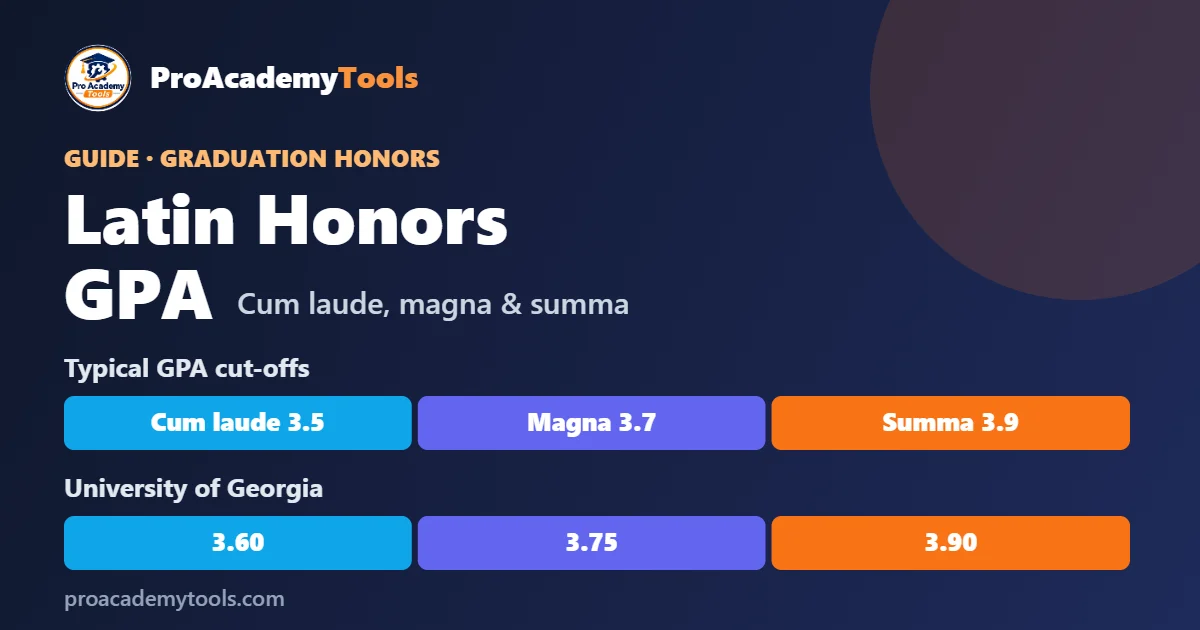
At most US colleges that use GPA cut-offs, cum laude (“with honor”) starts at about a 3.5 GPA, magna cum laude (“with great honor”) at about 3.7, and summa cum laude (“with highest honor”) at about 3.9, based on your cumulative GPA at graduation. The exact numbers vary: the University of Georgia uses 3.60 / 3.75 / 3.90, while Augusta University, Tennessee and Johnson & Wales use 3.50 / 3.70 / 3.90. Some colleges instead award honors to a set percentage of the graduating class.
Latin honors at a glance
| Honor | Meaning | Typical GPA | Roughly equals |
|---|---|---|---|
| Cum laude | “With honor” | 3.50–3.69 | A−/B+ average |
| Magna cum laude | “With great honor” | 3.70–3.89 | A− average |
| Summa cum laude | “With highest honor” | 3.90–4.00 | A average |
These are the most common cut-offs, not a national rule — every college sets its own. Latin honors are generally awarded to undergraduates finishing a bachelor’s degree and appear on your diploma and final transcript.
Real university examples
| University | Cum laude | Magna cum laude | Summa cum laude | Notable rule |
|---|---|---|---|---|
| Augusta University | 3.50–3.69 | 3.70–3.89 | 3.90–4.00 | Transfer students must meet the cut-off on both GPAs; no rounding |
| University of Tennessee, Knoxville | 3.50–3.69 | 3.70–3.89 | 3.90–4.00 | For catalog 2022-23 or later (earlier: 3.5 / 3.65 / 3.8) |
| Johnson & Wales University | 3.50–3.69 | 3.70–3.89 | 3.90–4.00 | Commencement listing uses the previous term’s GPA |
| University of Georgia | 3.60–3.74 | 3.75–3.89 | 3.90–4.00 | Counts transfer work; a 4.0 earns “First Honor Graduate” |
| Tulane School of Professional Advancement | 3.6 | 3.8 | 3.9 | GPA measured at graduation |
Notice how much the details matter: a 3.65 is cum laude at Augusta but not at Georgia, and a 3.78 is magna cum laude at Tennessee but only cum laude at Tulane SoPA. Always check your own college’s catalog — search for “graduation with honors” or “Latin honors”.
The rules that trip students up
- No rounding. A 3.499 is not a 3.5. Augusta’s policy, for example, states that GPAs are not rounded.
- Which GPA counts. Some colleges use only courses taken there; others (like Georgia) include all college-level transfer work. Augusta calculates both for transfer students and uses the lower one.
- Residency hours. Many colleges require a minimum number of credits completed at the institution — Augusta requires at least 60 semester hours in residence for a bachelor’s degree.
- Commencement vs diploma. Your graduation program may list honors from your GPA one term earlier; the final honor on your diploma uses your final GPA.
- Percentage-based systems. Some colleges cap honors at a share of the class (for example the top 5% for summa), so the GPA you need changes every year.
Can you still reach the next honor?
Because your GPA is a credit-weighted average, the closer you are to graduation, the harder it is to move. Credits of straight A’s needed to climb, by credits already completed:
| Current GPA → target | 60 credits done | 90 credits done | 105 credits done |
|---|---|---|---|
| 3.45 → 3.50 (cum laude) | 6 | 9 | 11 |
| 3.60 → 3.70 (magna) | 20 | 30 | 35 |
| 3.65 → 3.70 (magna) | 10 | 15 | 18 |
| 3.85 → 3.90 (summa) | 30 | 45 | 53 |
Formula: credits of A’s = credits done × (target − current) ÷ (4.0 − target). A senior with 105 credits at 3.85 would need 53 more credits of straight A’s to reach summa — more than a typical final year. Run your own numbers with the GPA raise calculator, and track each semester with the college GPA calculator.
Latin honors vs other academic honors
| Honor | Based on | When |
|---|---|---|
| Dean’s list | One term’s GPA (often 3.5+ with a full-time load) | Each semester |
| Latin honors | Cumulative GPA at graduation | At graduation |
| Departmental / program honors | Thesis or honors coursework plus GPA | At graduation |
| Honor societies (e.g. Phi Beta Kappa) | Selective invitation by GPA and coursework | Usually junior/senior year |
Do Latin honors matter?
They are a clear, recognized signal on a résumé and graduate-school application — “B.S., magna cum laude” tells a reader your GPA band at a glance. For jobs, they matter most in the first few years after graduation; graduate programmes look at your full transcript anyway. If you are close to a cut-off, it is worth planning your final semesters around it: check exactly what you need on each final with the final grade calculator, and see what your current number means in our GPA chart.
Frequently asked questions
What GPA is cum laude?
Usually 3.50 to 3.69 at colleges that use GPA cut-offs, but some start higher — the University of Georgia uses 3.60. Check your own college catalog.
What GPA is magna cum laude?
Usually 3.70 to 3.89. The University of Georgia uses 3.75 to 3.89, and Tulane’s School of Professional Advancement uses 3.8.
What GPA is summa cum laude?
Usually 3.90 to 4.00 — the most consistent cut-off across colleges. A few use percentage-of-class rules instead.
Is a 3.5 GPA cum laude?
At many colleges, yes — for example Augusta University, Tennessee and Johnson & Wales start cum laude at 3.50. At the University of Georgia you would need 3.60.
Do they round your GPA for Latin honors?
Usually not. Many colleges, including Augusta University, state explicitly that GPAs are not rounded, so a 3.499 does not count as 3.5.
Are there Latin honors for graduate degrees?
Generally no. Latin honors are an undergraduate distinction, although some graduate and professional programmes award their own distinctions.
Sources and methodology
University cut-offs were checked against each institution’s official page on November 3, 2026. Credits-to-target figures use the credit-weighted GPA formula and assume a 4.0 in every new credit, rounded up.
- Augusta University — Graduation honors policy
- University of Tennessee, Knoxville — Honors and levels of distinction
- Johnson & Wales University — Latin honors
- University of Georgia Registrar — Graduation honors
- Tulane School of Professional Advancement — Undergraduate Latin honors
Reviewed by the ProAcademy Tools editorial team. Found an error? Tell us — we correct mistakes quickly.