
How to Calculate CGPA (and Convert It to Percentage): Step-by-Step
CGPA confuses students because universities report it on different scales and some average semesters while others weight them by credits. This guide walks through the exact method, with worked examples for 10-point and 4.0 systems and the correct way to convert CGPA to a percentage.
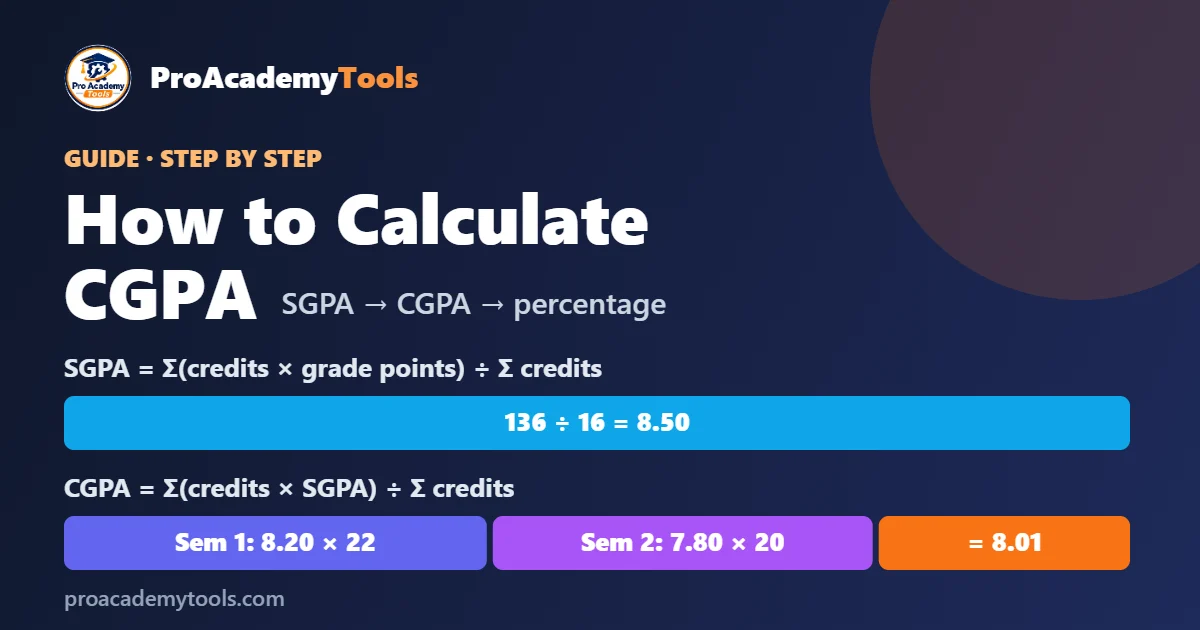
To calculate CGPA, first find each semester’s SGPA = Σ(credits × grade points) ÷ Σ credits, then CGPA = Σ(semester credits × SGPA) ÷ total credits. For example, SGPAs of 8.2 (22 credits) and 7.8 (20 credits) give (180.4 + 156) ÷ 42 = 8.01. Convert to a percentage only with your board’s or university’s formula — CBSE uses CGPA × 9.5.
SGPA, CGPA and GPA: what each one means
| Term | Stands for | Covers | Typical scale |
|---|---|---|---|
| SGPA | Semester Grade Point Average | One semester | 10 (India), 4.0 (Pakistan, US) |
| CGPA | Cumulative Grade Point Average | All semesters so far | Same scale as SGPA |
| GPA | Grade Point Average | Used for either, depending on country | Usually 4.0 |
Both SGPA and CGPA are credit-weighted averages: a 4-credit course counts four times as much as a 1-credit lab.
Step 1: Convert each grade to grade points
Use the grade-point table printed on your marksheet or in your university’s academic regulations. Two common examples:
| India (UGC 10-point) | Grade points | Pakistan / US (4.0 scale) | Grade points |
|---|---|---|---|
| O (Outstanding) | 10 | A | 4.00 |
| A+ (Excellent) | 9 | A− | 3.67 |
| A (Very good) | 8 | B+ | 3.33 |
| B+ (Good) | 7 | B | 3.00 |
| B (Above average) | 6 | B− | 2.67 |
| C (Average) | 5 | C+ | 2.33 |
| P (Pass) | 4 | C | 2.00 |
| F (Fail) | 0 | F | 0.00 |
Percentage bands for each grade differ between universities, so always use your own institution’s table.
Step 2: Calculate SGPA for each semester
SGPA = Σ(course credits × grade points) ÷ Σ course credits
Example semester on a 10-point scale:
| Course | Credits | Grade | Grade points | Credits × points |
|---|---|---|---|---|
| Mathematics | 4 | A+ | 9 | 36 |
| Physics | 3 | A | 8 | 24 |
| Programming | 3 | O | 10 | 30 |
| Chemistry | 3 | B+ | 7 | 21 |
| English | 2 | A | 8 | 16 |
| Physics Lab | 1 | A+ | 9 | 9 |
| Total | 16 | 136 |
SGPA = 136 ÷ 16 = 8.50. The CGPA calculator builds this table for you as you add courses.
Step 3: Combine semesters into CGPA
CGPA = Σ(semester credits × SGPA) ÷ Σ semester credits
| Semester | Credits | SGPA | Credits × SGPA |
|---|---|---|---|
| Semester 1 | 22 | 8.20 | 180.4 |
| Semester 2 | 20 | 7.80 | 156.0 |
| Total | 42 | 336.4 |
CGPA = 336.4 ÷ 42 = 8.01.
The most common mistake is averaging the SGPAs directly: (8.2 + 7.8) ÷ 2 = 8.00. That only gives the right answer when every semester has the same credits. Use credits unless your university’s regulations say otherwise — a few do use a simple average.
Worked example on a 4.0 scale (Pakistan HEC-style)
| Course | Credit hours | Grade | Grade points | Quality points |
|---|---|---|---|---|
| Calculus | 3 | A | 4.00 | 12.00 |
| Data Structures | 3 | A− | 3.67 | 11.01 |
| Digital Logic | 3 | B+ | 3.33 | 9.99 |
| Probability | 3 | B | 3.00 | 9.00 |
| Pakistan Studies | 2 | B− | 2.67 | 5.34 |
| Lab | 1 | A | 4.00 | 4.00 |
| Total | 15 | 51.34 |
GPA = 51.34 ÷ 15 = 3.42. Your CGPA then combines every semester’s quality points ÷ every semester’s credit hours. The Pakistan GPA & CGPA calculator uses this 4.0 grade-point scale.
How to convert CGPA to percentage
There is no universal formula — use the one your board or university publishes:
| Board / university | Formula | 8.4 CGPA becomes |
|---|---|---|
| CBSE (Class 10) | CGPA × 9.5 | 79.8% |
| Many Indian universities | CGPA × 10 | 84.0% |
| Some universities (e.g. VTU) | (CGPA − 0.75) × 10 | 76.5% |
For 4.0-scale CGPAs (Pakistan, the US), a percentage is not normally calculated from the CGPA. If an employer or foreign university asks, request an official equivalence or conversion certificate from your university. Try each formula with the CGPA to percentage calculator, and compare scales with the GPA scale chart.
Common mistakes to avoid
- Ignoring credits. A 1-credit lab and a 4-credit core course are not equal.
- Including failed courses incorrectly. Most universities include F grades (0 points) until the course is cleared; some replace them after a repeat. Follow your rules.
- Rounding SGPA before computing CGPA. Keep two or more decimals until the end.
- Mixing scales. Never average a 10-point SGPA with a 4.0 GPA — convert with official tables first.
Frequently asked questions
What is the formula for CGPA?
CGPA = Σ(semester credits × SGPA) ÷ Σ semester credits. Each SGPA is Σ(course credits × grade points) ÷ Σ course credits for that semester.
Is CGPA the average of SGPAs?
Only if every semester has the same number of credits. Otherwise you must weight each SGPA by its credits, or your CGPA will be slightly off.
How do I convert CGPA to percentage?
Use your board’s or university’s published formula. CBSE uses CGPA × 9.5, many Indian universities use CGPA × 10, and some use (CGPA − 0.75) × 10. Check the back of your marksheet.
What is a good CGPA?
On a 10-point scale, 8.0 or above is generally considered very good and 7.0+ good. On a 4.0 scale, 3.5 or above is very good and 3.0+ good. Many employers and master’s programmes set cut-offs around 6.0–7.0 (10-point) or 2.5–3.0 (4.0).
How can I calculate CGPA from percentage?
Reverse your university’s formula — for CBSE, CGPA = percentage ÷ 9.5. There is no single reverse formula for all universities.
Sources and methodology
Worked examples use the credit-weighted formulas shown. Grade-point tables are the UGC CBCS 10-point scale and a common 4.0 scale; your institution’s published table always takes priority.
- UGC — Guidelines on Adoption of Choice Based Credit System (grade points, SGPA and CGPA computation)
Reviewed by the ProAcademy Tools editorial team. Found an error? Tell us — we correct mistakes quickly.