
Bright Futures Scholarship Requirements: GPA, SAT/ACT and Hours (Class of 2027)
Florida’s Bright Futures program pays all or most of your public-college tuition — if you hit a GPA, a test score and an hours requirement before graduation. Here is exactly what the class of 2027 needs, how the special Bright Futures GPA is calculated, and how to check where you stand.
For students graduating in 2026-27 (class of 2027), the Florida Academic Scholars (FAS) award requires a 3.5 weighted GPA in 16 core credits, an SAT of 1330, ACT of 29 or CLT of 95, and 100 volunteer hours (or 100 paid work hours). The Florida Medallion Scholars (FMS) award requires a 3.0 weighted GPA, an SAT of 1190, ACT of 24 or CLT of 82, and 75 volunteer hours (or 100 work hours). FAS covers 100% of tuition and applicable fees at Florida public institutions; FMS covers 75%.
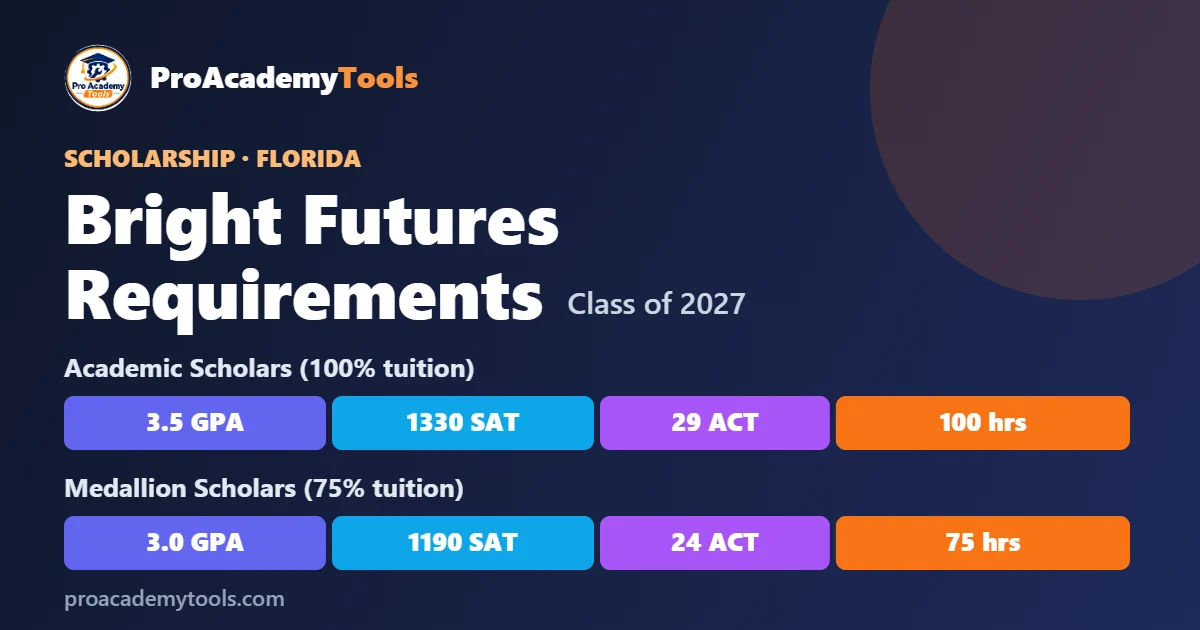
Bright Futures requirements at a glance (class of 2027)
| Requirement | Florida Academic Scholars (FAS) | Florida Medallion Scholars (FMS) |
|---|---|---|
| Weighted GPA (16 core credits) | 3.50 | 3.00 |
| SAT (combined) | 1330 | 1190 |
| ACT (composite) | 29 | 24 |
| CLT | 95 | 82 |
| Volunteer service hours | 100 | 75 |
| …or paid work hours | 100 | 100 |
| Award | 100% of tuition and applicable fees | 75% of tuition and applicable fees |
| GPA to renew in college | 3.0 | 2.75 |
You need all of the requirements for an award level — the GPA, one qualifying test score and the hours. Florida places you in the highest level you qualify for. There is also a Gold Seal Vocational Scholars award for career and technical students with different requirements.
Class of 2028 heads-up: test cut-offs rise to 1350 SAT / 29 ACT / 96 CLT for FAS and 1200 SAT / 25 ACT / 83 CLT for FMS. If you are a sophomore or junior, plan for the higher numbers.
How the Bright Futures GPA is calculated
The Bright Futures GPA is not the GPA on your report card. The state recalculates it from 16 core credits:
| Subject | Credits counted |
|---|---|
| English (three with substantial writing) | 4 |
| Mathematics (Algebra I and above) | 4 |
| Natural science (two with substantial lab) | 3 |
| Social science | 3 |
| World language (sequential, same language) | 2 |
Weighting: Florida adds 0.5 for each full-year course (0.25 for each semester) in approved advanced courses — AP, IB, Pre-IB, AICE, Pre-AICE, Honors and academic Dual Enrollment. So an A in a weighted course counts as 4.5 instead of 4.0. The GPA is calculated to two decimal places and is not rounded — a 3.49 does not become a 3.5. Electives and PE don’t count, though students may use up to two extra credits from the same core areas (or AP/IB/AICE fine arts) to raise the average.
Want a quick estimate? Enter only your core classes in the high school GPA calculator, mark advanced courses as Honors (+0.5), and compare the weighted result with 3.0 and 3.5. Your school counselor and the state’s evaluation are the official numbers.
Test score rules
- Only one qualifying score is needed — SAT, ACT or CLT.
- Superscoring within a test is allowed: Florida combines your best section scores from different sittings of the same test, but you cannot combine SAT and ACT sections.
- Scores must be earned by the test deadline for your graduating class (traditionally June 30 of senior year). Send official scores to your school district.
Check how close you are: estimate a practice test with the SAT score calculator or the ACT score calculator — its superscore tab shows how combining sittings helps.
Service and work hours
FAS students need 100 hours of approved volunteer service and FMS students 75 hours — or either level can use 100 hours of paid work. Hours must be approved and documented through your high school, so log them as you go and confirm your school’s approval process early. Rules for combining volunteer and work hours have changed over time, so confirm the current rule with your counselor.
How and when to apply
- Submit the Florida Financial Aid Application (FFAA) — it opens October 1 of your senior year and must be submitted by August 31 after graduation. Submitting early is better.
- Meet the residency and citizenship requirements: be a Florida resident and a US citizen or eligible noncitizen, and graduate from a Florida high school or registered home education program.
- Enrol at an eligible Florida institution — the award is not paid at out-of-state colleges.
How much is Bright Futures worth?
The award is paid per credit hour. At the University of Florida, the current published rates are $214.54 per credit hour for FAS (100% of tuition and applicable fees) and $160.90 for FMS (75%). Amounts differ by institution and are set each year. Over a four-year degree of 120 credits, FAS at that rate is worth more than $25,000.
Keeping Bright Futures in college
- GPA: a cumulative, unrounded, unweighted college GPA of 3.0 for FAS and 2.75 for FMS (an FAS student with 2.75–2.99 renews at the FMS level).
- Credits: full-time students must earn 24 credit hours per year (12 per term); part-time requirements are prorated.
- Limit: awards are generally available for up to 120 credit hours.
Track your college GPA term by term with the cumulative GPA calculator, and if it slips, the GPA raise calculator shows what you need to get back above the line.
Quick self-check
- Is my 16-core weighted GPA (not rounded) at least 3.0 — or 3.5 for FAS?
- Do I have one test score at the cut-off for my graduating class?
- Are 75 or 100 volunteer hours (or 100 work hours) logged and approved?
- Have I submitted the FFAA by August 31 after graduation?
If you answered “not yet” to the test score, that is usually the fastest one to fix — one more sitting and a superscore can be enough.
Frequently asked questions
What GPA do you need for Bright Futures?
A 3.0 weighted GPA in 16 core credits for Florida Medallion Scholars and a 3.5 for Florida Academic Scholars. The GPA is recalculated by the state from core courses only and is not rounded.
What SAT score do you need for Bright Futures in 2027?
For the class of 2027, Florida Academic Scholars need a 1330 SAT and Florida Medallion Scholars need a 1190. For the class of 2028 the cut-offs rise to 1350 and 1200.
Does Bright Futures superscore the SAT and ACT?
Yes. Florida combines your highest section scores from different sittings of the same test, but it does not mix SAT and ACT sections.
Can paid work hours count for Bright Futures?
Yes. Instead of volunteer service, students at either level can use 100 hours of paid work. Hours must be documented and approved through your school.
Do you need the FAFSA for Bright Futures?
No — Bright Futures uses the Florida Financial Aid Application (FFAA). The FAFSA is not required for Bright Futures, but filing it can unlock federal and other state aid.
Can Bright Futures be used out of state?
No. Bright Futures is paid only at eligible Florida public and private institutions.
Sources and methodology
Requirements are for students graduating in the 2026-27 academic year (class of 2027), checked on November 1, 2026. Florida can change requirements by statute each year; the Office of Student Financial Assistance’s evaluation is the official determination of eligibility.
- Florida Department of Education, OSFA — Bright Futures FAS/FMS initial eligibility chart (2026-27), as summarised by FL Test Prep
- Florida Department of Education — Bright Futures Student Handbook, Chapter 1: Initial Eligibility (GPA weighting and core credits)
- University of Florida Student Financial Aid — Bright Futures program details (award rates and renewal)
- Florida Student Scholarship & Grant Programs — Bright Futures
Reviewed by the ProAcademy Tools editorial team. Found an error? Tell us — we correct mistakes quickly.