
What Is a Good GPA? High School, College & Grad School Guide
A plain-English guide to GPA ranges — what counts as good in high school, college and graduate admissions, how your number compares with the national average, and what to do if you want it higher.
On the standard 4.0 scale, a 3.0 GPA (a B average) is generally considered good, a 3.5 or higher is very good, and 3.7 or above is competitive for the most selective colleges, scholarships and graduate programs. For context, the average GPA of US high school graduates was 3.11 in the most recent national transcript study, and the average college GPA is a little above 3.1. What counts as “good” ultimately depends on your goal — a 3.3 can be excellent for one program and below average for another.
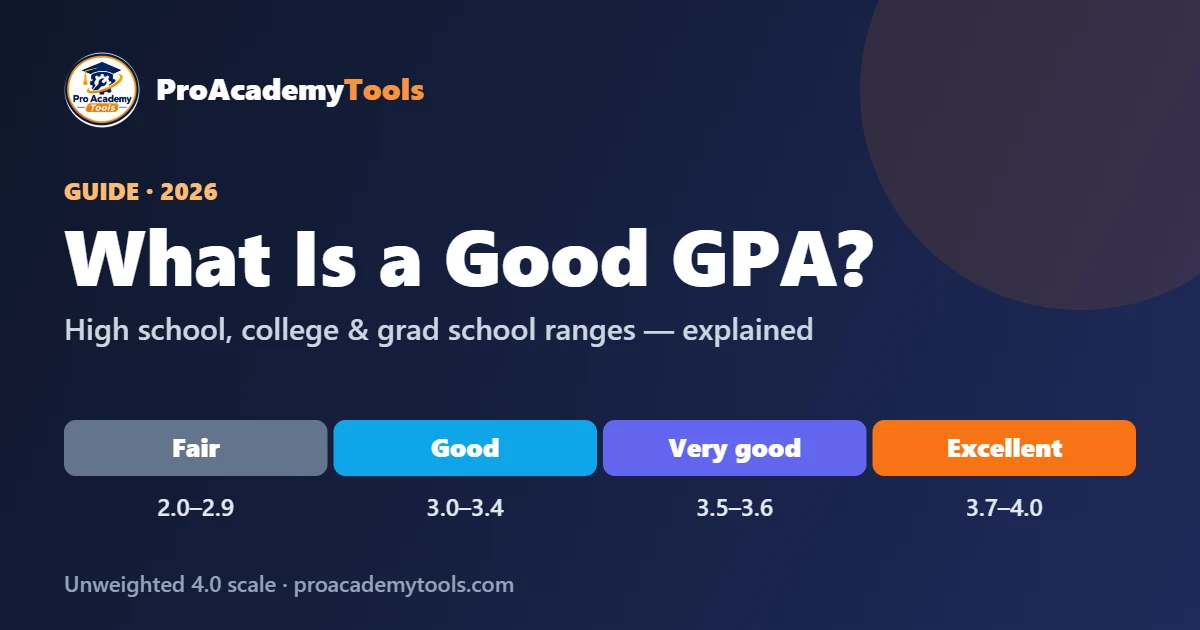
GPA ranges at a glance
Most US high schools and colleges use the same unweighted 4.0 scale, where each letter grade earns grade points (A = 4.0, B = 3.0, C = 2.0). Your GPA is the average of those points across your courses. Here is how each range is usually read by admissions offices and employers:
| GPA (4.0 scale) | Letter average | Approx. percentage | What it usually means |
|---|---|---|---|
| 4.0 | A | 93–100% | Straight A’s — the top of the scale |
| 3.7–3.9 | A− | 90–92% | Excellent; competitive for highly selective colleges |
| 3.3–3.6 | B+ | 87–89% | Very good; clearly above the national average |
| 3.0–3.2 | B | 83–86% | Good; meets most scholarship and graduate-school minimums |
| 2.5–2.9 | B− / C+ | 77–82% | Fair; accepted by many colleges, but below average |
| 2.0–2.4 | C | 73–76% | Passing, but below most competitive cut-offs |
| Below 2.0 | D / F | Below 73% | Risk of academic probation at most colleges |
Percentage cut-offs vary from school to school, so treat the middle column as a guide. If your report card shows percentages or letter grades instead of a GPA, convert them with our grade converter or compare scales on the GPA scale chart.
What is a good GPA in high school?
A 3.0 or higher is a good high school GPA, and 3.5 or higher is very good. The useful benchmark is the national average: according to the National Assessment Governing Board’s High School Transcript Study, the class of 2019 graduated with an average GPA of 3.11, up from 3.00 in 2009. Grades have crept up over time, so a GPA that looked impressive a generation ago is closer to average today.
Grades matter more in college admissions than almost anything else. In NACAC’s State of College Admission report, 79% of colleges said grades in college-prep courses were of “considerable importance” — more than any other factor in the survey. Admissions officers also look at:
- Course rigor. A 3.6 earned in honors, AP or IB classes often impresses more than a 3.9 in the easiest available classes.
- Your grade trend. Rising grades from 9th to 11th grade tell a better story than a strong start followed by a decline.
- Your school’s context. Colleges read your transcript alongside your school’s profile, so they know how hard your school grades.
With early decision and early action deadlines falling in October and November and regular deadlines soon after, many seniors are checking these numbers right now. Your colleges will see your grades through the end of junior year (plus any senior-year grades your school reports), so the classes you are taking this semester still count. Calculate yours with the high school GPA calculator, which shows both weighted and unweighted results.
What is a good weighted GPA?
A weighted GPA adds extra points for advanced classes — typically +0.5 for honors and +1.0 for AP or IB courses — so it can go above 4.0, usually up to 5.0. A weighted GPA of 4.0 or higher is strong, because it means you are earning mostly A’s and B’s in advanced courses. Because every high school weights differently, many colleges recalculate your GPA on their own scale. That is why it is worth knowing your unweighted GPA too: it is the number that compares most fairly across schools. For a full explanation with a worked example, read our guide to weighted vs unweighted GPA.
| Unweighted GPA | Weighted GPA | |
|---|---|---|
| Scale | 0.0–4.0 | Usually 0.0–5.0 |
| Extra points for honors/AP/IB | No | Yes (+0.5 to +1.0) |
| Good | 3.0+ | 3.5+ |
| Very good | 3.5+ | 4.0+ |
| Best for comparing schools | Yes | No — weighting rules differ |
What is a good GPA in college?
In college, a 3.0 is generally considered good, 3.5 is very good and 3.7 or above is excellent. Research on grade inflation by Stuart Rojstaczer and Christopher Healy found that the average US college GPA had risen to about 3.15, with roughly 45% of all grades being A’s. In other words, a 3.0 is now slightly below the typical college average, while a 3.5 puts you comfortably above it.
What matters most is the next step you are aiming for:
| Your goal | GPA that is usually competitive | Why |
|---|---|---|
| Staying in good academic standing | 2.0+ | Most colleges place students below 2.0 on academic probation |
| Graduate school (master’s or PhD) | 3.0+ minimum; 3.5+ competitive | Many graduate schools, such as the University of Illinois, set a 3.0 minimum |
| Medical school | 3.7+ | The 2025 entering class averaged a 3.81 GPA (AAMC) |
| Competitive internships and jobs | 3.0–3.5+ | Many employers that ask for GPA screen at 3.0 or above |
| Merit scholarships and honors | 3.0–3.5+ | Thresholds vary — check each scholarship’s rules |
A few notes on these numbers. Graduate programs often look most closely at your last two years or your major GPA, so a weak first year can be outweighed by strong upper-level grades. And for medical school, the AAMC reports that the average GPA of all applicants in 2025 was 3.67 — noticeably lower than the 3.81 average of those who enrolled.
To see how a new semester changes your overall number, use the cumulative GPA calculator.
Is my GPA good? Quick answers for every GPA
What is a good GPA outside the US?
Many countries do not use the US 4.0 system. Here is how “good” is usually described on other common scales:
- India (10-point CGPA): A CGPA of 8.0 or higher is generally considered very good and 9.0+ excellent. CBSE’s conversion multiplied CGPA by 9.5 to give a percentage — try it in the CGPA to percentage calculator.
- Pakistan (HEC 4.0 scale): Most universities follow the HEC-recommended 4.0 scale. A CGPA of 3.0 or above is generally seen as good and 3.5+ as excellent, but MS/MPhil programs and scholarships set their own minimums. Work out your CGPA with the Pakistan GPA calculator.
- United Kingdom (degree classes): A First (70%+) is the top class and an Upper Second, or 2:1 (60–69%), is the level many graduate employers and master’s programs ask for. Estimate yours with the UK degree classification calculator.
- Australia (WAM and 7-point GPA): Universities report a weighted average mark; at many universities a Distinction starts at 75 and a High Distinction at 85. Use the WAM calculator to check.
How to calculate your GPA in three steps
- Convert each grade to points. On the 4.0 scale an A is 4.0, an A− 3.7, a B+ 3.3 and a B 3.0.
- Multiply by credits. An A− (3.7) in a 3-credit course earns 11.1 quality points.
- Divide total points by total credits.
Example: an A in a 3-credit course (12 points), a B in a 4-credit course (12 points) and an A− in a 3-credit course (11.1 points) give 35.1 points over 10 credits — a 3.51 GPA. The cumulative GPA calculator does this for you and combines it with your previous GPA.
How to raise your GPA
Because GPA is an average weighted by credits, it gets harder to move the more credits you have already completed. Suppose you have a 3.2 GPA after 60 credits and take 30 more:
| Average in your next 30 credits | New cumulative GPA |
|---|---|
| 3.5 | 3.30 |
| 3.8 | 3.40 |
| 4.0 | 3.47 |
Even a perfect semester lifts a 3.2 to about 3.47 — so start early and focus on what you can control:
- Find out what you need on each final. The final grade calculator shows the exam score that gets you to your target, so you can prioritize the right classes.
- Track your weighted class grades. Use the weighted grade calculator to see how much each assignment category is worth.
- Protect your high-credit courses. A 4-credit class moves your GPA more than a 1-credit one.
- Use your college’s grade replacement or retake policy if it has one — some colleges replace a failed grade when you retake the course.
- Get help early. Office hours, tutoring centers and study groups work best before a midterm, not after the final.
Does GPA matter after graduation?
GPA matters most at the transition points — applying to college, graduate school, scholarships and your first job. Some employers ask for it on entry-level applications, while others focus on skills, internships and interviews. Once you have work experience, your GPA usually matters far less. That is why the best time to improve it is while it still counts.
Frequently asked questions
What is a normal GPA?
The national average is a little above 3.0. US high school graduates averaged a 3.11 GPA in the most recent national transcript study (class of 2019), and the average college GPA is about 3.15 according to grade-inflation research.
Is a 3.5 GPA good in college?
Yes. A 3.5 is a very good college GPA — above the average of about 3.15 — and it meets the dean’s-list threshold at many colleges and the competitive range for most graduate programs.
Can you have a GPA above 4.0?
Only with a weighted GPA. Weighted scales add extra points for honors, AP or IB classes, so they usually run up to 5.0. On the standard unweighted scale the maximum is 4.0.
Do colleges look at weighted or unweighted GPA?
Both, but many colleges recalculate your GPA using their own method, often based on unweighted grades in core academic courses, while also rewarding the rigor of your schedule.
What GPA is too low for college?
Many colleges admit students with GPAs between 2.0 and 2.5, and community colleges generally have open admission. Selective colleges usually expect 3.5 or higher.
Is GPA more important than test scores?
For most colleges, yes. In NACAC’s State of College Admission survey, grades in college-prep courses were the factor most often rated of considerable importance — ahead of test scores.
Sources and methodology
GPA ranges use the standard US 4.0 letter-grade scale; percentage bands are typical and vary by school. Averages and admission figures come from the official sources below.
- National Assessment Governing Board — High School Transcript Study (class of 2019)
- NACAC — Factors in College Admission
- AAMC — U.S. Medical Schools Enroll Record Number of Students (2025)
- University of Illinois Graduate College — Minimum Admission Requirements
- BigFuture (College Board) — Early Decision and Early Action Calendar
- The Fiscal Times — Rojstaczer and Healy grade inflation data
Reviewed by the ProAcademy Tools editorial team. Found an error? Tell us — we correct mistakes quickly.