
How to Calculate GPA: Step-by-Step Formula with Examples
Your GPA is just a credit-weighted average of grade points. Once you know the four steps, you can work out your semester, cumulative, weighted or unweighted GPA by hand in a couple of minutes — and check it against your transcript.
To calculate GPA, convert each letter grade to grade points (A = 4, B = 3, C = 2, D = 1, F = 0), multiply each by the class credit hours, add the results, then divide by your total credits. Example: an A in a 3-credit class (12 points) and a B in a 4-credit class (12 points) give 24 ÷ 7 = 3.43 GPA. The cumulative GPA calculator does this instantly.
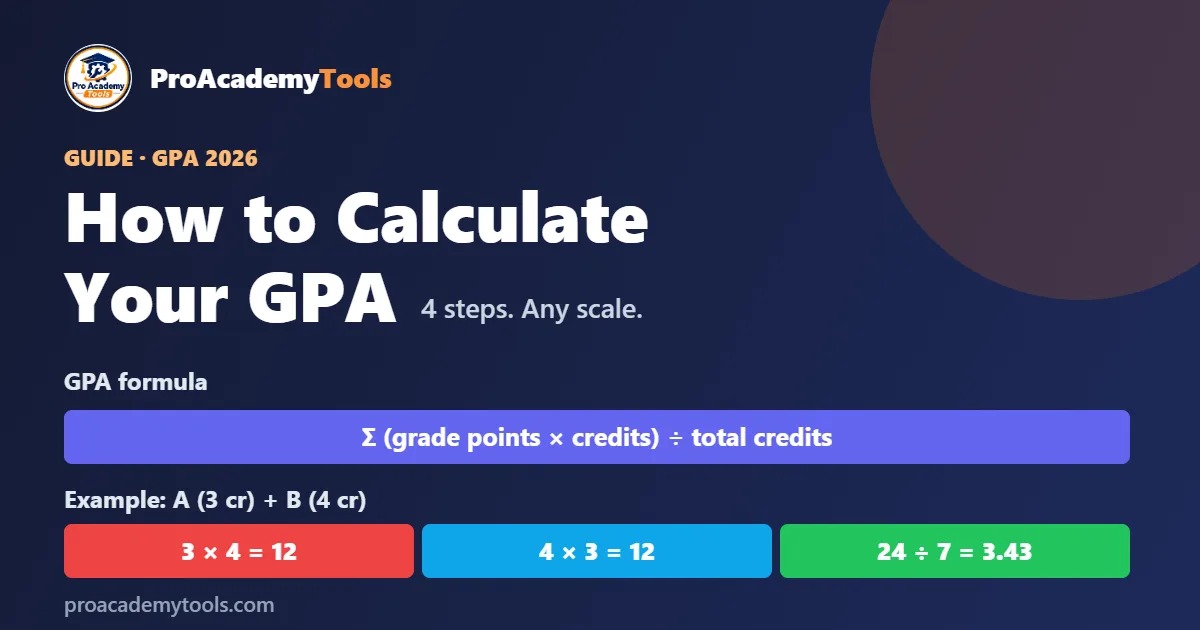
The GPA formula
GPA = Σ (grade points × credit hours) ÷ Σ credit hours
That is all a grade point average is: every class contributes its grade points, weighted by how many credits (or units) it is worth. A 4-credit lab science counts more than a 1-credit elective, so it moves your GPA more.
Step 1: Convert each letter grade to grade points
Most US high schools and colleges use the standard 4.0 scale. Many colleges also use plus/minus grades:
| Letter grade | Percentage (typical) | Grade points |
|---|---|---|
| A+ / A | 93–100% | 4.0 |
| A− | 90–92% | 3.7 |
| B+ | 87–89% | 3.3 |
| B | 83–86% | 3.0 |
| B− | 80–82% | 2.7 |
| C+ | 77–79% | 2.3 |
| C | 73–76% | 2.0 |
| C− | 70–72% | 1.7 |
| D+ | 67–69% | 1.3 |
| D | 63–66% | 1.0 |
| D− | 60–62% | 0.7 |
| F | Below 60% | 0.0 |
Your school’s catalog is the final word — some count A+ as 4.3, and percentage cut-offs vary. See the full GPA scale and our grading scale guide for common variations.
Step 2: Multiply grade points by credit hours
The result for each class is called quality points (or honor points).
| Class | Grade | Grade points | Credits | Quality points |
|---|---|---|---|---|
| Biology | A− | 3.7 | 4 | 14.8 |
| English Composition | B+ | 3.3 | 3 | 9.9 |
| Calculus I | B | 3.0 | 4 | 12.0 |
| Psychology | A | 4.0 | 3 | 12.0 |
| Physical Education | A | 4.0 | 1 | 4.0 |
| Total | 15 | 52.7 |
Step 3: Add quality points and credits
Add the last two columns: 52.7 quality points and 15 credits. Leave out pass/fail (P/NP), audited and withdrawn (W) classes — they usually carry credits but no grade points. An F, however, does count: 0 quality points with full credits.
Step 4: Divide
52.7 ÷ 15 = 3.51 GPA. Most schools report GPA to two decimal places and do not round up (a 3.497 stays 3.49 on many transcripts).
How to calculate GPA in high school
High schools often give every class the same weight (for example 1 credit per year-long course or 0.5 per semester). If all credits are equal, the formula becomes a simple average:
Unweighted high school GPA = sum of grade points ÷ number of classes
Example: A, A, B, B, C over five classes = (4 + 4 + 3 + 3 + 2) ÷ 5 = 3.2.
How to calculate weighted GPA
A weighted GPA adds a bonus for harder courses so an A in AP Chemistry is worth more than an A in a standard class. The most common weighting is:
| Course level | Bonus | An A is worth | A B is worth |
|---|---|---|---|
| Standard / college prep | +0 | 4.0 | 3.0 |
| Honors | +0.5 | 4.5 | 3.5 |
| AP / IB / dual enrollment | +1.0 | 5.0 | 4.0 |
Add the bonus to each class’s grade points first, then use the same formula. Example: A in AP Biology (5.0), B in Honors English (3.5), A in Algebra II (4.0), B in History (3.0) = 15.5 ÷ 4 = 3.88 weighted (3.5 unweighted). Schools differ — some give no bonus for D or F grades, and some cap weighted GPA — so check your district policy. Our high school GPA calculator shows both numbers side by side, and weighted vs unweighted GPA explains which one colleges look at.
How to calculate GPA in college
College GPA uses the credit-weighted formula above, with each course’s credit hours (or units) from your registration record. Two college-specific rules matter:
- Repeated courses: many colleges replace the old grade with the new one (grade forgiveness); others average both. Your registrar’s policy decides.
- Transfer credit: credits from another college usually count toward your degree but not your GPA.
How to calculate cumulative GPA
Cumulative GPA covers every term, not just the last one. Do not average your semester GPAs — that only works if every semester had the same number of credits. Instead, combine the totals:
Cumulative GPA = total quality points (all terms) ÷ total credits (all terms)
| Term | Credits | Term GPA | Quality points (credits × GPA) |
|---|---|---|---|
| Fall | 15 | 3.51 | 52.65 |
| Spring | 12 | 3.00 | 36.00 |
| Cumulative | 27 | 88.65 ÷ 27 = 3.28 |
Averaging the two GPAs would give 3.26 — close, but wrong, and the gap grows when credit loads differ more. The cumulative GPA calculator handles this for you.
How to convert a percentage to GPA
If your school reports percentages, first turn each percentage into a letter grade using your school’s grading scale, then into grade points. For example, 88% is a B+ (3.3) on the common plus/minus scale. Use the grade converter for quick conversions, or see the full percentage to GPA chart. Outside the US, schools often use other scales — see the CGPA calculator for 10-point systems.
Common GPA calculation mistakes
- Averaging semester GPAs instead of weighting by credits.
- Forgetting an F — it adds credits with zero points and pulls your GPA down hard.
- Including pass/fail classes in the credit total.
- Using the wrong scale — mixing a 4.3 scale with a 4.0 scale, or adding AP bonuses to a GPA that should be unweighted.
- Rounding up — 3.495 is usually reported as 3.49, not 3.5.
What to do with your GPA
Once you know the number, see what counts as a good GPA for your goals, or plan your next term with the GPA raise calculator, which shows the grades you need to reach a target. Our guide on how to raise your GPA covers the strategies that move it fastest.
Frequently asked questions
How do I calculate my GPA quickly?
Convert each grade to points (A = 4, B = 3, C = 2, D = 1, F = 0), multiply by the class credits, add the results and divide by total credits. If every class has the same credits, just average the grade points.
How do you calculate GPA on a 4.0 scale?
Use 4.0 for an A, 3.0 for a B, 2.0 for a C, 1.0 for a D and 0 for an F (with plus/minus steps of about 0.3), weight each by credit hours and divide the total by your credits. The maximum unweighted GPA is 4.0.
How do you calculate weighted GPA?
Add a bonus to each advanced class before averaging, typically +0.5 for Honors and +1.0 for AP, IB or dual-enrollment courses, so an A in an AP class counts as 5.0. Then divide the total by the number of classes or credits.
Do pass/fail classes count toward GPA?
Usually not. A pass earns credits toward graduation but no grade points, so it is left out of both totals. A fail in a pass/fail class may count at some schools, so check your policy.
Can I average my semester GPAs to get cumulative GPA?
Only if every semester had the same credit load. Otherwise multiply each term GPA by its credits, add those quality points and divide by total credits.
Is GPA rounded?
Most schools truncate or round to two decimal places. Many do not round 3.495 up to 3.50, so check how your transcript reports it before relying on a cut-off.
Sources and methodology
Examples use the common US 4.0 plus/minus scale (A− = 3.7, B+ = 3.3) and the +0.5 / +1.0 Honors and AP weighting used by many districts. Results are shown to two decimal places.
Reviewed by the ProAcademy Tools editorial team. Found an error? Tell us — we correct mistakes quickly.