
How Long Does It Take to Read 100 Pages? (By Reading Speed)
The average adult reads about 238–260 words per minute, and a typical book page holds around 250–300 words. Put those together and 100 pages takes most people just under two hours — but your real time depends on your speed, the book and why you are reading it.
It takes about 1 hour 50 minutes to read 100 pages at an average reading speed of 250 words per minute, assuming around 275 words per page (a typical paperback). A fast reader at 400 wpm finishes in about 70 minutes; a slower or careful reader at 150–200 wpm needs 2¼–3 hours. Dense textbooks can take twice as long. Get your exact time with the reading time calculator.
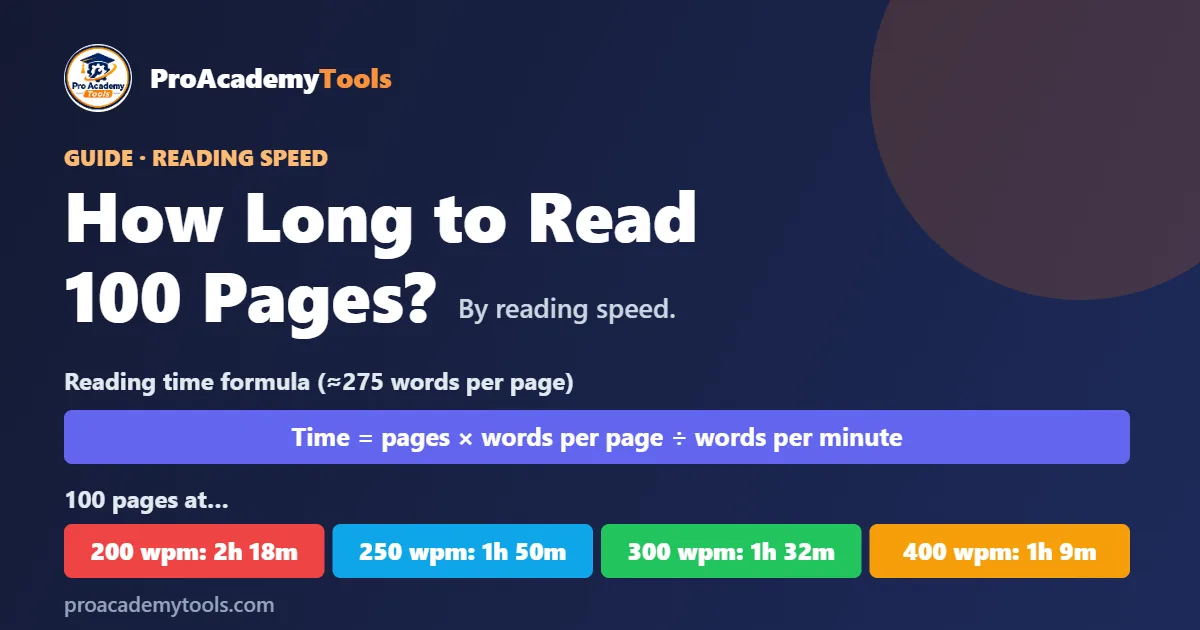
How long to read 100 pages at each reading speed
Times below assume 275 words per page, a typical paperback novel (100 pages ≈ 27,500 words).
| Reading speed | Type of reader | Time for 100 pages | Pages per hour |
|---|---|---|---|
| 150 wpm | Slow, careful or studying | 3 h 3 min | 33 |
| 200 wpm | Below average | 2 h 18 min | 44 |
| 250 wpm | Average adult (silent reading) | 1 h 50 min | 55 |
| 300 wpm | Above average | 1 h 32 min | 65 |
| 350 wpm | Fast | 1 h 19 min | 76 |
| 400 wpm | Very fast | 1 h 9 min | 87 |
| 500 wpm | Skimming | 55 min | 109 |
The formula: time (minutes) = pages × words per page ÷ words per minute. For 100 pages: 100 × 275 ÷ 250 = 110 minutes.
What is the average reading speed?
The most thorough answer comes from a 2019 meta-analysis of 190 studies covering about 18,000 readers, which found that adults reading English silently average about 238 words per minute for non-fiction and 260 words per minute for fiction. Reading aloud is much slower — around 183 wpm — which is close to the pace of a professional audiobook narrator.
| Reading situation | Typical speed |
|---|---|
| Reading aloud / audiobook pace | 150–185 wpm |
| Studying a textbook (with notes) | 100–200 wpm |
| Silent reading, non-fiction | ~238 wpm |
| Silent reading, fiction | ~260 wpm |
| Skimming for the main idea | 400–700 wpm |
Claims of reading 1,000+ words per minute with full understanding are not supported by eye-movement research: above roughly 400–500 wpm, readers are skimming and comprehension drops.
How many words are on a page?
Page counts mislead because pages vary a lot. Typical ranges:
| Book type | Words per page | 100 pages at 250 wpm |
|---|---|---|
| Children’s chapter book | 100–200 | 40–80 min |
| Mass-market paperback | 250–300 | 1 h 40 min – 2 h |
| Trade paperback / novel | 300–350 | 2 h – 2 h 20 min |
| Hardcover non-fiction | 350–450 | 2 h 20 min – 3 h |
| Academic textbook | 450–600 | 3–4 h (often more for studying) |
| Double-spaced essay (12 pt) | ~250–300 | 1 h 40 min – 2 h |
| Single-spaced document (12 pt) | ~500–550 | 3 h 20 min – 3 h 40 min |
If you know the word count instead of the page count, skip the page estimate and divide words by your wpm — the reading time calculator accepts either.
How long does it take to read a book?
At 250 wpm and ~275 words per page:
| Book length | Words (approx.) | Reading time |
|---|---|---|
| 100 pages | 27,500 | 1 h 50 min |
| 200 pages | 55,000 | 3 h 40 min |
| 300 pages | 82,500 | 5 h 30 min |
| 400 pages | 110,000 | 7 h 20 min |
| 500 pages | 137,500 | 9 h 10 min |
Reading 30 minutes a day, that is a 300-page novel in about 11 days — or roughly 33 books a year.
How to measure your own reading speed
- Pick a normal page from the kind of book you read most.
- Count the words on 3 full lines, divide by 3, and multiply by the number of lines on the page — that is your words per page.
- Set a timer for 5 minutes and read at your normal pace, understanding what you read.
- Count the pages (or lines) you covered, convert to words, and divide by 5.
Example: you read 4.5 pages of 300 words in 5 minutes → 1,350 ÷ 5 = 270 wpm. Now multiply: 100 pages × 300 ÷ 270 = 111 minutes.
What changes how long 100 pages takes
- Purpose: reading for an exam is slower than reading for fun. Plan roughly double your leisure time for textbooks you need to remember.
- Difficulty: technical vocabulary, formulas and unfamiliar topics slow everyone down.
- Language: reading in a second language is often 20–40% slower.
- Format: small fonts, narrow margins and dense layouts pack more words per page.
- Breaks and focus: phone notifications can add more time than a slow reading speed.
Planning reading for school or university
If a syllabus assigns 100 pages a week, budget about 2 hours for a novel and 3–4 hours for a textbook, then spread it over several sessions. Use the reading time calculator to estimate each assignment, and protect the time you need for revision before exams — the final grade calculator shows how much your final exam can still move your grade. For long reading lists, also keep an eye on class attendance: see how to calculate attendance percentage.
Frequently asked questions
How long does it take to read 100 pages?
About 1 hour 50 minutes for an average adult reading at 250 words per minute, with roughly 275 words per page. Fast readers need about 70 minutes; slower readers 2½–3 hours.
How many pages can you read in an hour?
At an average 250 words per minute, about 55 pages of a typical paperback per hour. At 300 wpm it is about 65 pages; at 200 wpm about 44 pages.
What is a good reading speed?
The adult average for silent reading is about 238–260 words per minute. Anything from 250–350 wpm with good comprehension is a solid reading speed for most purposes.
How long does it take to read 50 pages?
About 55 minutes at 250 words per minute and 275 words per page — half the time for 100 pages.
How long does it take to read a 300-page book?
Around 5½ hours at an average reading speed, or about 11 days if you read 30 minutes a day.
Can speed reading help me read 100 pages faster?
Skimming can cover pages faster, but research on eye movements shows comprehension drops sharply above about 400–500 words per minute. For studying, reading carefully is usually more efficient.
Sources and methodology
Reading times = pages × words per page ÷ words per minute, rounded to the nearest minute. Average speeds come from Brysbaert (2019); words-per-page ranges are typical publishing figures and vary by edition.
- Brysbaert, M. (2019). How many words do we read per minute? A review and meta-analysis of reading rate. Journal of Memory and Language, 109.
- Rayner, K., Schotter, E. R., Masson, M. E. J., Potter, M. C., & Treiman, R. (2016). So much to read, so little time: How do we read, and can speed reading help? Psychological Science in the Public Interest, 17(1).
Reviewed by the ProAcademy Tools editorial team. Found an error? Tell us — we correct mistakes quickly.