
How to Calculate Cumulative GPA: Formula, Examples and Retakes
Your cumulative GPA is the single number that follows you to scholarships, honors and applications. It is simple to calculate, but it is not the average of your semester GPAs, and retakes, pass/fail classes and transfer credits can change it. Here is the formula, a full worked example and what real colleges do in those special cases.
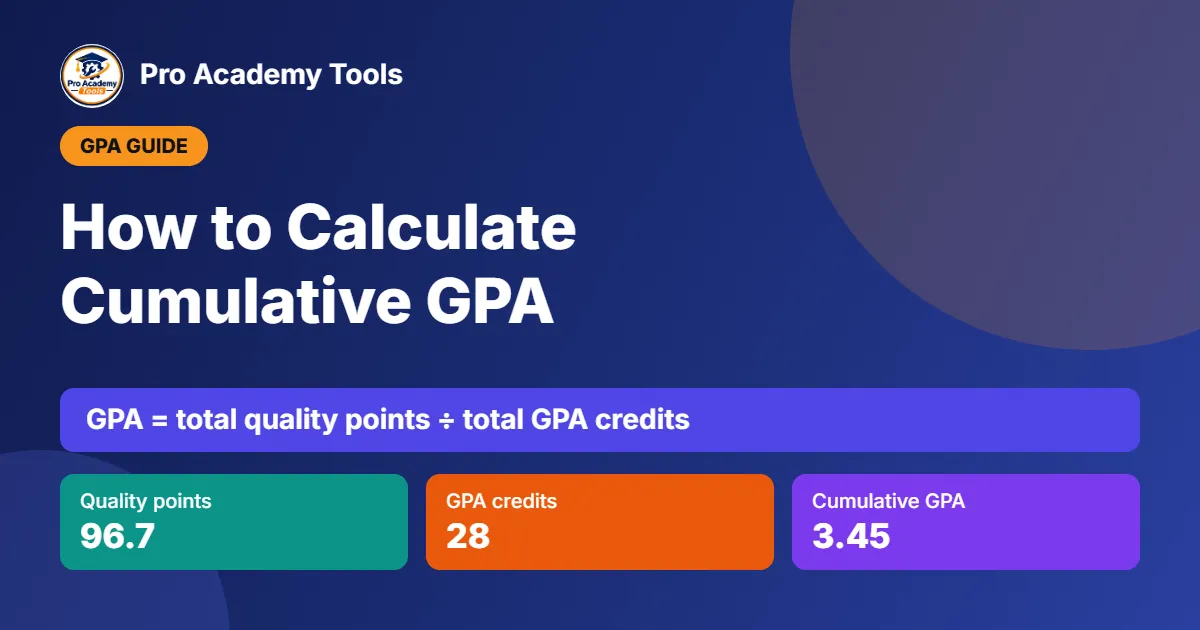
Cumulative GPA = total quality points ÷ total GPA credits, across every term. A course’s quality points are its grade points times its credits (an A in a 3-credit course is 4.0 × 3 = 12). For example, 45.3 quality points over 13 credits in the fall and 51.4 over 15 in the spring give (45.3 + 51.4) ÷ (13 + 15) = 3.45. Do not average your semester GPAs, because credit loads differ. Try it in the cumulative GPA calculator.
What is cumulative GPA?
Cumulative GPA is your grade point average across every term you have completed. A term GPA only reflects the courses from that semester. At the University of Arizona, for example, the cumulative GPA covers all courses in your career program, and undergraduate and graduate programs keep separate GPAs.
| Semester (term) GPA | Cumulative GPA | |
|---|---|---|
| Covers | One term | All terms so far |
| Used for | Dean’s List, term standing | Graduation, honors, scholarships, applications |
| Changes | Resets every term | Moves slowly as credits build up |
See what is a good GPA for how these numbers are judged.
The cumulative GPA formula
Grade points come from your college’s scale. On the standard plus/minus scale an A is 4.0, A− 3.7, B+ 3.3, B 3.0, B− 2.7, C+ 2.3, C 2.0 and F 0.0 (see the GPA scale chart and grading scale).
Step-by-step example
Step 1: Calculate quality points for each course.
Fall semester, 13 credits:
| Course | Grade | Grade points | Credits | Quality points |
|---|---|---|---|---|
| Biology | A | 4.0 | 3 | 12.0 |
| Calculus | B+ | 3.3 | 4 | 13.2 |
| English | B | 3.0 | 3 | 9.0 |
| History | A− | 3.7 | 3 | 11.1 |
| Total | 13 | 45.3 |
Fall GPA = 45.3 ÷ 13 = 3.48.
Spring semester, 15 credits:
| Course | Grade | Grade points | Credits | Quality points |
|---|---|---|---|---|
| Chemistry | A− | 3.7 | 3 | 11.1 |
| Psychology | B | 3.0 | 3 | 9.0 |
| Economics | B+ | 3.3 | 3 | 9.9 |
| Statistics | A | 4.0 | 4 | 16.0 |
| Art | B− | 2.7 | 2 | 5.4 |
| Total | 15 | 51.4 |
Spring GPA = 51.4 ÷ 15 = 3.43.
Step 2: Add all quality points and all credits.
Quality points: 45.3 + 51.4 = 96.7. Credits: 13 + 15 = 28.
Step 3: Divide.
Cumulative GPA = 96.7 ÷ 28 = 3.45.
Why you should not average your semester GPAs
Cumulative GPA is weighted by credits. Say you earned a 3.80 over 12 credits in one term and a 3.00 over 18 credits in the next:
- Simple average of the two GPAs: (3.80 + 3.00) ÷ 2 = 3.40
- Correct cumulative GPA: (3.80 × 12 + 3.00 × 18) ÷ 30 = 99.6 ÷ 30 = 3.32
The heavier semester should count for more, and the credit-weighted method makes it happen.
How to add a new semester to your current GPA
You do not need every old grade. Turn your current GPA back into quality points, add the new term, and divide again.
Example. You have a 3.40 GPA over 45 credits, and this term you earn 45.3 quality points over 13 credits:
(3.40 × 45 + 45.3) ÷ (45 + 13) = (153 + 45.3) ÷ 58 = 198.3 ÷ 58 = 3.42.
To work in the other direction and find the term GPA you need to reach a target, use the GPA raise calculator or read how to raise your GPA.
What counts toward cumulative GPA, and what does not
Rules differ by college. These published policies show the common patterns:
| Situation | What colleges do | Examples |
|---|---|---|
| Pass/fail courses | Usually left out of GPA | Georgia Tech excludes pass/fail and audit courses. Boise State leaves out P, incomplete, withdrawal and audit grades. |
| Failing grades | Count as 0.0 quality points | Boise State’s scale counts F at 0.0 in the GPA. |
| Retaking a course | Varies a lot (see below) | Memphis drops the first attempt and Montana counts only the most recent grade. Boise State has used both averaging (for repeats from fall 1995 to summer 2001) and replacement (since fall 2001). |
| Transfer credits | Often credit only, not grades | The University of Montana leaves transfer grades out of the institutional cumulative GPA. The University of Southern Indiana counts transfer courses in earned hours but not GPA hours. |
| Rounding | Some truncate | Georgia Tech and Johnson & Wales cut the GPA off after two decimals, so 3.156 becomes 3.15. |
Always check your own college’s registrar page, because the rule that applies to you is the one in your catalog.
How a retake changes your cumulative GPA
Suppose you have 60 credits and a 3.00 GPA (180 quality points), and that includes a 3-credit course where you earned a D (3.0 quality points). You retake it and earn an A (12.0 quality points).
| Policy | Calculation | New cumulative GPA |
|---|---|---|
| Grade replacement (only the new grade counts) | (180 − 3 + 12) ÷ 60 = 189 ÷ 60 | 3.15 |
| Every attempt counts (grades are averaged) | (180 + 12) ÷ (60 + 3) = 192 ÷ 63 | 3.05 |
Replacement lifts the GPA by 0.15, while counting both attempts lifts it by about 0.05. Many colleges also cap how many courses you may replace. Georgia Tech, for example, allows grade substitution for up to two courses with a D or F.
Cumulative GPA vs major GPA
Your college may also calculate a major GPA from only the courses in your major, and sometimes a separate GPA for a minor. The formula is the same, but only the relevant courses go into the totals. Programs often set a minimum major GPA on top of the overall one.
How to find your own cumulative GPA
- Open your unofficial transcript in your student portal. It normally lists term and cumulative GPA.
- Check the GPA hours (not just earned hours) shown next to it, because pass/fail and transfer credits may be excluded.
- Compare it with the cumulative GPA calculator using your quality points and credits.
- If the numbers differ, look up your college’s policy on repeats, transfers and rounding.
If you want to see how this semester will move your overall average before grades post, use the cumulative GPA calculator with your expected grades, and the final grade calculator to work out the score each class needs. High school students can use the high school GPA calculator, which also handles weighted classes.
Frequently asked questions
How do you calculate cumulative GPA?
Multiply each course’s grade points by its credits to get quality points, add the quality points from every term, and divide by the total GPA credits. For example, 96.7 quality points over 28 credits gives a cumulative GPA of 3.45.
Is cumulative GPA the average of semester GPAs?
No. It is weighted by credits. A 3.80 over 12 credits and a 3.00 over 18 credits give a cumulative GPA of 3.32, not the simple average of 3.40.
How do I add a new semester to my cumulative GPA?
Use (current GPA × credits completed + new quality points) ÷ (credits completed + new credits). With a 3.40 over 45 credits and 45.3 new quality points over 13 credits, the new cumulative GPA is 3.42.
Does retaking a class replace the old grade?
It depends on the college. Some replace the first grade with the second, some count only the most recent attempt, and some include every attempt in the average. A D replaced by an A in a 3-credit course can raise a 60-credit 3.00 GPA to 3.15 under replacement but only to 3.05 if both attempts count.
Do pass/fail classes count in cumulative GPA?
Usually not. Colleges such as Georgia Tech and Boise State leave pass/fail and similar grades out of GPA, although the credits may still count toward graduation.
Do transfer credits count in cumulative GPA?
At many colleges transfer credits count toward your degree but their grades are left out of the institutional GPA, for example at the University of Montana and the University of Southern Indiana. Check your registrar’s policy.
What is a good cumulative GPA?
Colleges set their own minimums, and the University of Southern Indiana, for example, requires a 2.0 to graduate. Scholarships and honors usually ask for more, so see our guide to what is a good GPA.
Sources and methodology
Cumulative GPA is calculated as total quality points divided by total GPA credits, the method published by the registrars listed above. Examples use the standard 4.0 plus/minus scale and are rounded to two decimal places. College policies on repeats, transfer credits, pass/fail and rounding were checked on their published pages in November 2026 and can change, so your own college’s catalog always takes priority.
- University of Arizona Registrar — Grades and GPA calculation
- University of Montana Registrar — Grade Point Average
- University of Memphis Registrar — GPA and repeated courses
- Boise State University — Policy 3230: Calculation of GPA
- Georgia Tech Registrar — How GPA is calculated
- Georgia Tech Catalog — Grades and average (grade substitution)
- Johnson & Wales University — Grade point average policy
- University of Southern Indiana Registrar — Grade point average
Reviewed by the ProAcademy Tools editorial team. Found an error? Tell us — we correct mistakes quickly.