
Grading Scale: Letter Grade to Percentage Chart (A to F)
Most US schools turn percentages into letter grades with a 10-point scale — 90% and up is an A — but plus/minus cut-offs, 7-point scales and college policies vary. This chart shows every common version and how each grade converts to GPA.
On the standard US grading scale, A = 90–100%, B = 80–89%, C = 70–79%, D = 60–69% and F = below 60%, worth 4.0, 3.0, 2.0, 1.0 and 0 GPA points. With plus/minus grades, the top 3 points of each band are a plus (e.g. 87–89% = B+) and the bottom 3 are a minus (80–82% = B−). Convert any score with the grade converter.
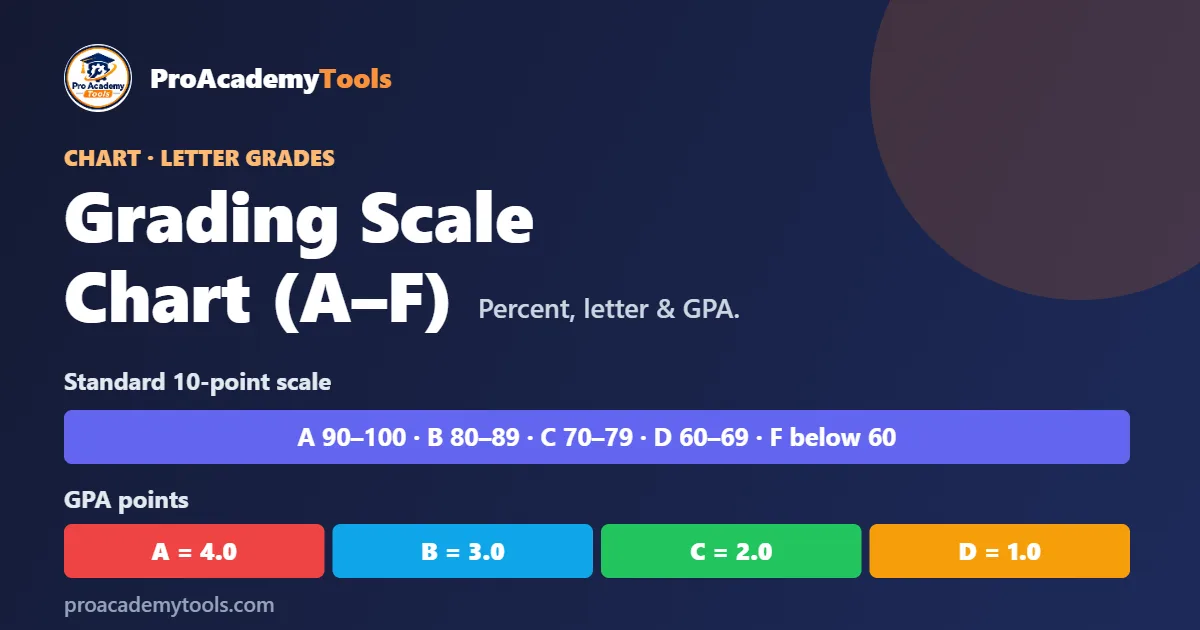
Standard grading scale (10-point scale)
This is the most common grading scale in US middle schools, high schools and colleges:
| Letter grade | Percentage | GPA points | What it means |
|---|---|---|---|
| A | 90–100% | 4.0 | Excellent |
| B | 80–89% | 3.0 | Good / above average |
| C | 70–79% | 2.0 | Satisfactory / average |
| D | 60–69% | 1.0 | Passing, below average |
| F | 0–59% | 0.0 | Failing |
Plus/minus grading scale chart
Many schools — especially colleges — split each letter into plus and minus grades:
| Letter grade | Percentage | GPA points |
|---|---|---|
| A+ | 97–100% | 4.0 (4.3 at some schools) |
| A | 93–96% | 4.0 |
| A− | 90–92% | 3.7 |
| B+ | 87–89% | 3.3 |
| B | 83–86% | 3.0 |
| B− | 80–82% | 2.7 |
| C+ | 77–79% | 2.3 |
| C | 73–76% | 2.0 |
| C− | 70–72% | 1.7 |
| D+ | 67–69% | 1.3 |
| D | 63–66% | 1.0 |
| D− | 60–62% | 0.7 |
| F | 0–59% | 0.0 |
For how these points become a grade point average, see the GPA scale and how to calculate GPA.
What letter grade is…?
Quick answers on the standard plus/minus scale:
| Score | Letter grade | Score | Letter grade |
|---|---|---|---|
| 95% | A | 75% | C |
| 92% | A− | 72% | C− |
| 90% | A− | 70% | C− |
| 89% | B+ | 69% | D+ |
| 85% | B | 65% | D |
| 82% | B− | 60% | D− |
| 80% | B− | 59% | F |
| 79% | C+ | 50% | F |
What grade is a 70? A 70% is a C− on a plus/minus scale and a C on a simple A–F scale — the lowest C. On a 7-point scale it is a D.
7-point grading scale
Some school districts and private schools use a stricter 7-point scale:
| Letter grade | 10-point scale | 7-point scale |
|---|---|---|
| A | 90–100% | 93–100% |
| B | 80–89% | 85–92% |
| C | 70–79% | 77–84% |
| D | 60–69% | 70–76% |
| F | Below 60% | Below 70% |
On a 7-point scale an 88% is a B instead of a B+, and a 69% is failing. If your school uses it, your GPA may look lower than a student with the same percentages elsewhere — colleges are aware of this and read GPAs in the context of each school’s profile.
Other grading systems you may see
| System | Where it’s used | How it works |
|---|---|---|
| 4.0 GPA scale | US high schools and colleges | Letters converted to 0–4 points (GPA scale) |
| Weighted 5.0 scale | US high schools with Honors/AP | +0.5 or +1.0 bonus for advanced classes (weighted vs unweighted GPA) |
| Pass/Fail | Electives, some first-year college courses | No letter grade; usually excluded from GPA |
| Standards-based (1–4) | Many elementary schools | 4 = exceeds, 3 = meets, 2 = approaching, 1 = beginning the standard |
| E instead of F | Some districts | E is used for failing so it is not confused with “Fair” |
| 10-point CGPA | India, Pakistan and others | See what is CGPA and the CGPA to percentage converter |
How to convert a percentage to a letter grade
- Work out your percentage: points earned ÷ points possible × 100. A 43/50 test is 86%. The test grade calculator does this and prints a full chart for any number of questions.
- Find the band your percentage falls into on your school’s scale.
- Check rounding rules. Many teachers round 89.5% up to 90% (an A−); others truncate. The syllabus or student handbook says which.
If your class grade comes from weighted categories (tests 40%, homework 20%…), calculate the weighted percentage first — see how to calculate weighted grades.
To go one step further and turn your percentages into GPA points, see percentage to GPA.
How to convert a letter grade to a percentage
A letter grade covers a range, so there is no single exact percentage. If you need one number (for example, to fill in a form that asks for a percentage), use the midpoint of the band: A ≈ 95%, B ≈ 85%, C ≈ 75%, D ≈ 65%. If the form asks for your GPA instead, use the GPA column above.
Is a C a passing grade?
Yes — a C (70–79%) is passing and usually counts as “satisfactory.” A D (60–69%) is also passing in most classes, but many colleges require a C or better for a course to count toward your major or as a prerequisite, and some high schools require a C for course credit. See what is a passing GPA for minimum GPA rules.
Frequently asked questions
What is the standard grading scale?
The most common US grading scale is A = 90–100%, B = 80–89%, C = 70–79%, D = 60–69% and F = below 60%, worth 4, 3, 2, 1 and 0 GPA points.
What percentage is a B+?
On the standard plus/minus scale a B+ is 87–89% and is worth 3.3 GPA points.
What grade is an 80?
An 80% is a B− on a plus/minus scale and a B on a simple A–F scale. On a 7-point scale, an 80% is a C.
Is a 60 passing?
On a 10-point scale, 60% is a D−, which is technically passing. On a 7-point scale anything below 70% fails, and many colleges require a C or better for major courses.
What is a 4.0 grading scale?
It is the US system that converts letter grades into points: A = 4.0, B = 3.0, C = 2.0, D = 1.0, F = 0. A 4.0 GPA means straight A’s.
Why do schools use different grading scales?
Grading policies are set by each district, school or college, so cut-offs vary. Colleges compare applicants using each high school’s profile, which explains its grading scale.
Sources and methodology
The standard and plus/minus charts reflect the most widely used US cut-offs. Your school’s official policy, published in its handbook or catalog, always takes precedence.
Reviewed by the ProAcademy Tools editorial team. Found an error? Tell us — we correct mistakes quickly.