
What Is a Passing GPA? High School, College & Graduate School (2026)
“Passing” means different things depending on what you need to pass — a single class, a semester, your financial aid or your degree. Here are the GPA minimums that apply at each stage, what happens if you fall below them, and how to recover.
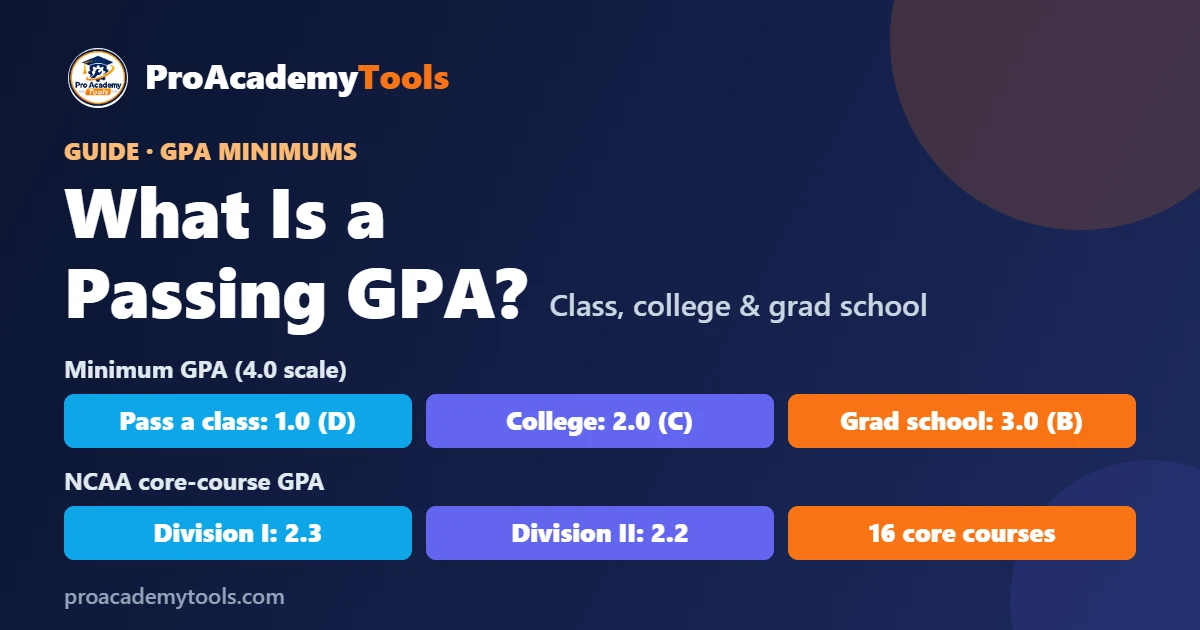
A D (1.0 on the 4.0 scale) is usually the lowest passing grade for an individual class, and anything below it — an F (0.0) — is failing. But a 2.0 GPA (a C average) is the minimum that most US colleges treat as passing overall: you typically need a 2.0 cumulative GPA to stay in good academic standing, keep financial aid and graduate. Graduate programs usually require a 3.0 (B average), and NCAA Division I athletes need a 2.3 core-course GPA in high school.
Passing GPA at a glance
| What you need to pass | Usual minimum GPA | Letter grade |
|---|---|---|
| A single class (most high schools and colleges) | 1.0 | D |
| A class that counts toward your major or a prerequisite | Often 2.0 | C |
| Good academic standing in college | 2.0 cumulative | C average |
| Financial aid (satisfactory academic progress) | 2.0 cumulative at most colleges | C average |
| A bachelor’s degree | 2.0 cumulative | C average |
| Good standing in graduate school | 3.0 | B average |
| NCAA Division I eligibility (high school core courses) | 2.3 | C+ |
| NCAA Division II eligibility (high school core courses) | 2.2 | C+ |
These are typical figures — your school’s catalog has the exact rules, and some programs set higher minimums.
Passing grades on the 4.0 scale
| Letter grade | Percentage (typical) | Grade points | Passing? |
|---|---|---|---|
| A | 90–100% | 4.0 | Yes |
| B | 80–89% | 3.0 | Yes |
| C | 70–79% | 2.0 | Yes |
| D | 60–69% | 1.0 | Passes the class, but often not enough for major or prerequisite courses |
| F | Below 60% | 0.0 | No — failing |
Many schools also use plus and minus grades (for example B+ = 3.3 and C− = 1.7). See the full GPA scale chart for 4.0, 4.33 and 5.0 scales.
Is a 2.0 GPA passing?
Yes — 2.0 is the standard minimum for passing overall in college. At the University of Kansas, for example, students need a semester and cumulative GPA of at least 2.0 to stay in good academic standing and a 2.0 cumulative GPA to graduate. Coppin State University requires undergraduates to keep a 2.0 (at least a C average) for financial aid, and graduate students a 3.0.
But 2.0 is a floor, not a target: a 2.0 is well below the average college GPA, and many graduate schools, scholarships and employers look for 3.0 or higher. See what a good GPA is or check where yours stands on our Is a 2.0 GPA good? page.
What GPA is failing?
- Below 1.0 for a class — an F (0.0) means you did not pass and earn no credit.
- Below 2.0 cumulative in college — you are not failing your courses, but most colleges place you on academic probation (or warning). If your GPA stays below 2.0 for further terms, you can be suspended or dismissed.
- Below 2.0 for financial aid — at most colleges this means you are not making satisfactory academic progress, which can put federal aid on hold until you file a successful appeal or raise your GPA.
High school: what is a passing GPA?
In most US high schools a D (1.0) passes a course and earns credit toward graduation, so the technical minimum GPA to graduate can be as low as about 1.0. In practice, many districts and states require a 2.0 GPA for sports and extracurricular eligibility, and colleges look for much higher — the average US high school graduate’s GPA is about 3.1.
Student-athletes: to compete in their first year of college, the NCAA requires a 2.3 core-course GPA for Division I and 2.2 for Division II across 16 approved core courses (standardized test scores are no longer required).
How to get back above a passing GPA
- Find out exactly what you need. Use the GPA raise calculator to see the term GPA that takes you back above 2.0.
- Retake failed courses where your college replaces the old grade — an F replaced by a B can lift your GPA quickly.
- Take a manageable load of courses you can do well in, rather than the maximum.
- Use academic support — tutoring, office hours and your advisor; most probation plans require it anyway.
- Track every term with the cumulative GPA calculator. For the full strategy, read how to raise your GPA.
Outside the US? A passing CGPA works differently — on India’s UGC 10-point scale the pass grade is P = 4. See what CGPA means.
Frequently asked questions
What is a passing GPA in college?
A D (1.0) usually passes an individual class, but most colleges require a cumulative 2.0 GPA (a C average) to stay in good academic standing, keep financial aid and graduate.
Is a 2.0 GPA passing?
Yes. A 2.0 is the standard minimum for good academic standing and graduation at most US colleges, but it is below average and many scholarships and graduate programs expect 3.0 or more.
Is a D a passing grade?
A D (1.0) usually passes a class and earns credit, but many colleges require at least a C (2.0) in major courses and prerequisites, so a D may not count toward your degree requirements.
What GPA is failing?
An F (0.0) fails a class. A cumulative GPA below 2.0 in college usually leads to academic probation and can affect financial aid.
What is the minimum GPA for graduate school?
Most graduate programs require students to keep at least a 3.0 (B average) to remain in good standing.
What GPA do you need for NCAA eligibility?
A 2.3 core-course GPA for Division I and 2.2 for Division II, across 16 NCAA-approved core courses.
Sources and methodology
Minimums reflect common US college policies, illustrated with published academic standing and financial aid policies. NCAA figures are the current initial-eligibility core-course GPA minimums. Checked on November 5, 2026.
- University of Kansas — Minimum graduation GPA and academic probation
- Coppin State University — Satisfactory Academic Progress qualitative requirements
- College Board — NCAA course work requirements
- SwimSwam — NCAA permanently eliminates standardized test score requirement for Division I and II
Reviewed by the ProAcademy Tools editorial team. Found an error? Tell us — we correct mistakes quickly.