
How to Calculate SGPA: Full Form, Formula and Step-by-Step Example
Your semester result shows an SGPA, not marks. Here is exactly how universities calculate it from your credits and grade points, a full worked example, how SGPA differs from CGPA, and how to turn it into a percentage.
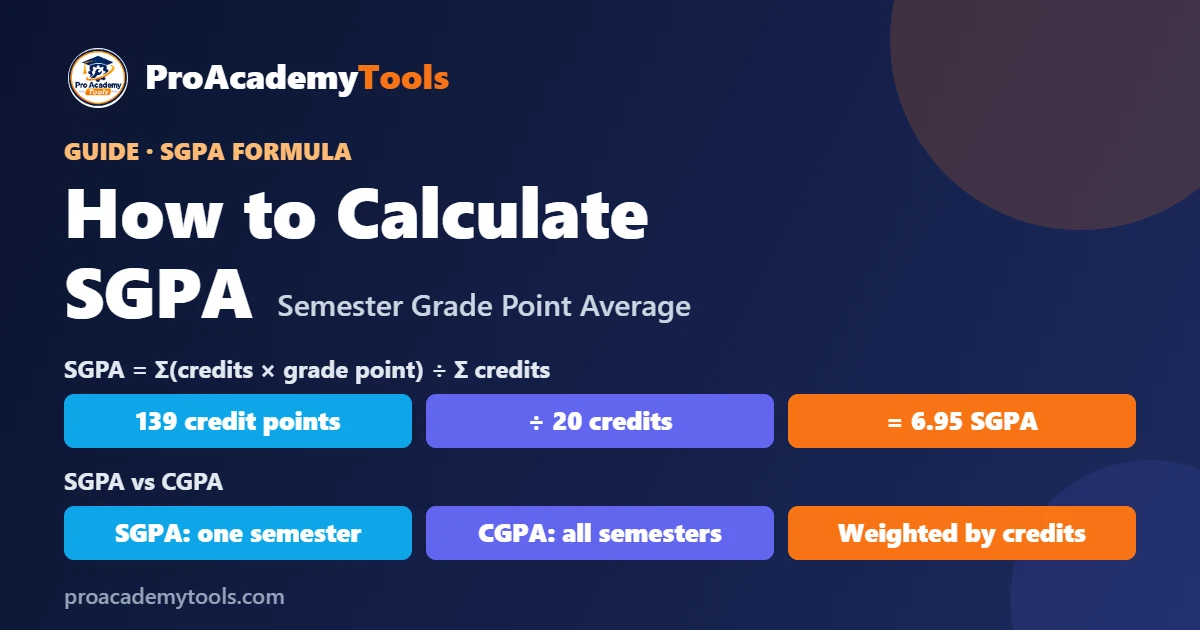
SGPA (Semester Grade Point Average) = Σ(course credits × grade point) ÷ Σ course credits. Multiply each course’s credits by the grade point you earned, add the results and divide by the semester’s total credits. In UGC’s example, six courses worth 20 credits earn 139 credit points, so SGPA = 139 ÷ 20 = 6.95. SGPA covers one semester; your CGPA is the credit-weighted average of all your SGPAs.
SGPA full form and meaning
SGPA stands for Semester Grade Point Average. It is your result for a single semester, calculated from the grade point you earned in each course and the number of credits that course carries. Mumbai University calls it SGPI (Semester Grade Performance Index) and some institutes call it SPI — the calculation is the same.
The SGPA formula
SGPA = Σ(Cᵢ × Gᵢ) ÷ Σ Cᵢ
- Cᵢ = credits of course i (from your syllabus or marksheet)
- Gᵢ = grade point earned in course i (from your university’s grade table)
- Cᵢ × Gᵢ = the credit points for that course
Most Indian universities follow the UGC 10-point scale: O = 10, A+ = 9, A = 8, B+ = 7, B = 6, C = 5, P = 4, F = 0. Your university sets the marks range for each grade.
How to calculate SGPA: step by step
- List every course in the semester with its credits.
- Find the grade point for each course from your grade (for example, A = 8).
- Multiply credits × grade point for each course to get credit points.
- Add all the credit points.
- Add all the credits.
- Divide total credit points by total credits, and round to two decimals.
Worked example (UGC illustration)
| Course | Credits | Grade | Grade point | Credits × grade point |
|---|---|---|---|---|
| Course 1 | 3 | A | 8 | 24 |
| Course 2 | 4 | B+ | 7 | 28 |
| Course 3 | 3 | B | 6 | 18 |
| Course 4 | 3 | O | 10 | 30 |
| Course 5 | 3 | C | 5 | 15 |
| Course 6 | 4 | B | 6 | 24 |
| Total | 20 | 139 |
SGPA = 139 ÷ 20 = 6.95
A simple average of the six grade points would be 42 ÷ 6 = 7.0 — slightly higher, because the 4-credit courses where this student scored B+ and B pull the weighted result down. Always weight by credits. Enter your own subjects in the SGPA calculator to get your SGPA and its percentage instantly, or use the CGPA calculator to combine semesters.
Common SGPA mistakes
- Leaving out failed courses. An F counts as 0 grade points but its credits still count, which lowers your SGPA until you clear the course and the result is revised.
- Counting non-credit courses. Audit courses and other zero-credit courses don’t enter the calculation.
- Averaging grade points. As the example shows, an unweighted average gives the wrong answer when courses have different credits.
- Rounding too early. Keep full decimals until the final division; UGC asks universities to report SGPA to two decimal places.
SGPA vs CGPA: what’s the difference?
| SGPA | CGPA | |
|---|---|---|
| Full form | Semester Grade Point Average | Cumulative Grade Point Average |
| Covers | One semester | All semesters completed so far |
| Calculated from | Course credits × grade points | Semester credits × SGPA |
| Changes | Fixed once the semester result is out | Updates after every semester |
| Used for | Semester result, backlog tracking | Degree result, placements, higher studies |
From SGPA to CGPA
CGPA = Σ(semester credits × SGPA) ÷ Σ semester credits
| Semester | Credits | SGPA | Credits × SGPA |
|---|---|---|---|
| 1 | 20 | 6.95 | 139.0 |
| 2 | 22 | 7.80 | 171.6 |
| 3 | 24 | 8.10 | 194.4 |
| Total | 66 | 505.0 |
CGPA = 505 ÷ 66 = 7.65. Read more in what CGPA means.
SGPA to percentage
Universities apply their CGPA formula to SGPA too. The most common rules:
| University | Formula | SGPA 7.5 becomes |
|---|---|---|
| Anna University, VTU (2021 scheme on) | SGPA × 10 | 75.0% |
| KTU, JNTUH, GTU | (SGPA − 0.5) × 10 | 70.0% |
| VTU (2015–2018 schemes), MAKAUT | (SGPA − 0.75) × 10 | 67.5% |
| AKTU | SGPA × 10 − 7.5 | 67.5% |
| Delhi University | SGPA × 9.5 | 71.25% |
| Mumbai University (engineering) | 7.1 × SGPA + 11 | 64.25% |
See every university’s rule in our SGPA to percentage guide, or convert instantly with the CGPA to percentage calculator. Going the other way, the percentage to CGPA calculator reverses each formula.
Frequently asked questions
What is the full form of SGPA?
SGPA stands for Semester Grade Point Average — your credit-weighted grade point average for one semester.
How do you calculate SGPA?
Multiply each course’s credits by the grade point you earned, add the results, and divide by the total credits for the semester. For example, 139 credit points ÷ 20 credits = an SGPA of 6.95.
What is the difference between SGPA and CGPA?
SGPA covers a single semester. CGPA is the average of all your semesters so far, weighted by each semester’s credits, so it changes after every semester.
How do I calculate CGPA from SGPA?
Multiply each SGPA by that semester’s credits, add the results and divide by the total credits. For example, (20 × 6.95 + 22 × 7.8 + 24 × 8.1) ÷ 66 = 7.65.
Does a failed subject count in SGPA?
Yes. A failed course earns 0 grade points but its credits are still included, so it lowers your SGPA until you clear the course and your result is revised.
How do I convert SGPA to percentage?
Use your university’s formula: SGPA × 10 at Anna University and VTU (2021 scheme), (SGPA − 0.5) × 10 at KTU, JNTUH and GTU, and SGPA × 9.5 at Delhi University.
Sources and methodology
The SGPA and CGPA formulas and the six-course example follow the UGC Choice Based Credit System guidelines. Percentage formulas are those published by each university. Checked on November 5, 2026.
- UGC — Guidelines on Adoption of Choice Based Credit System (SGPA/CGPA formulas and illustration)
- Evaluation in Choice Based Credit System in Higher Education (UGC 10-point letter grades)
- Exammint — University SGPA/CGPA conversion rules compiled from official regulations
Reviewed by the ProAcademy Tools editorial team. Found an error? Tell us — we correct mistakes quickly.