
Weighted vs Unweighted GPA: What’s the Difference and Which Do Colleges Use?
Your report card may show two GPAs. Here is what each one measures, how to calculate both, and which number colleges actually use when they read your application.
An unweighted GPA treats every class the same on a 0–4.0 scale, while a weighted GPA adds extra points for harder classes — usually +0.5 for honors and +1.0 for AP, IB or dual-enrollment courses — so it can go above 4.0, typically up to 5.0. Colleges see both: the Common App asks you to report the weighted GPA when your school calculates both, but many colleges recalculate your GPA on their own scale, which is why your unweighted GPA and the difficulty of your courses matter just as much.
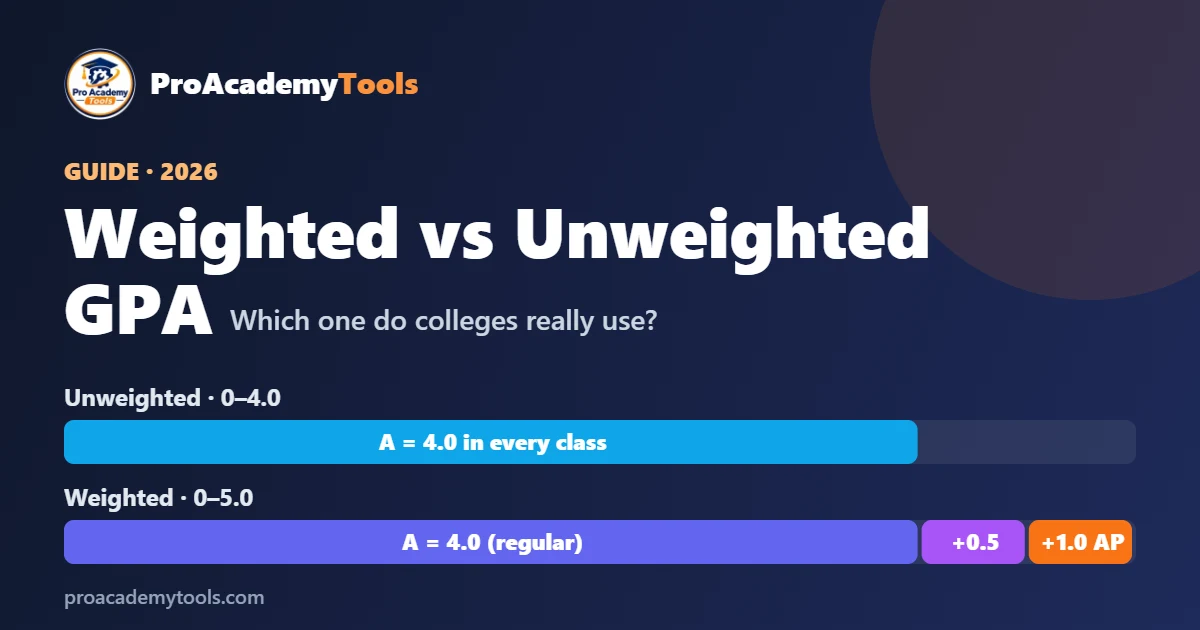
Weighted vs unweighted GPA at a glance
| Unweighted GPA | Weighted GPA | |
|---|---|---|
| Scale | 0.0–4.0 | Usually 0.0–5.0 (some schools use 4.5 or 6.0) |
| An A in a regular class | 4.0 | 4.0 |
| An A in an honors class | 4.0 | Usually 4.5 |
| An A in an AP, IB or dual-enrollment class | 4.0 | Usually 5.0 |
| What it shows | How well you did | How well you did and how hard your classes were |
| Comparable between schools? | Yes — same scale everywhere | No — every school sets its own weighting |
| Used in college? | Yes — college GPAs are unweighted | Rarely |
The short version: unweighted GPA measures your grades; weighted GPA measures your grades plus the difficulty of your schedule. Neither one is “the real GPA” — they answer different questions, which is why colleges look at both.
What is an unweighted GPA?
An unweighted GPA is the classic 4.0 scale. Every class counts the same, whether it is AP Physics or a first-year elective: an A is worth 4.0 points, a B 3.0, a C 2.0, a D 1.0 and an F 0. Many schools also use plus and minus grades (A− = 3.7, B+ = 3.3), and a few count an A+ as 4.33 — compare scales on our GPA scale chart.
Because it ignores course difficulty, an unweighted GPA cannot go above 4.0. That makes it the fairest number for comparing students from different high schools, and it is also how college GPAs work — universities almost never weight courses.
How to calculate your unweighted GPA
- Convert each final grade to points on the 4.0 scale (A = 4.0, A− = 3.7, B+ = 3.3, B = 3.0 and so on).
- Multiply by the course credits if your classes carry different credits (a full-year class often counts double a semester class).
- Add up the points and divide by the total credits.
If your report card shows percentages, convert them to letter grades first with the grade converter.
What is a weighted GPA?
A weighted GPA gives bonus points for advanced classes, so a student who takes a harder schedule is not penalized for earning a B in AP Chemistry instead of an A in a regular class. Weighting rules are set by each school or district, but the most common pattern is:
| Course level | Points for an A | Points for a B | Bonus |
|---|---|---|---|
| Regular / college-prep | 4.0 | 3.0 | +0.0 |
| Honors | 4.5 | 3.5 | +0.5 |
| AP, IB or dual enrollment | 5.0 | 4.0 | +1.0 |
Some schools add a full point for honors too, some only weight grades of C or better, and some cap how many weighted classes count. Check your school’s course guide or student handbook for its exact rules.
How to calculate your weighted GPA
- Convert each grade to points on the 4.0 scale.
- Add the bonus for that class: +0.5 for honors or +1.0 for AP, IB or dual enrollment (or whatever your school uses).
- Multiply by credits, add everything up and divide by total credits — exactly like an unweighted GPA.
Our weighted GPA calculator does both calculations at once: enter each class, choose regular, honors or AP/IB, and it shows your weighted and unweighted GPA side by side.
Worked example: one student, two GPAs
Here is a junior taking six equal-credit classes:
| Class | Level | Grade | Unweighted points | Weighted points |
|---|---|---|---|---|
| English 11 | Honors | A | 4.0 | 4.5 |
| AP Calculus AB | AP | B+ | 3.3 | 4.3 |
| AP Biology | AP | A− | 3.7 | 4.7 |
| Spanish III | Regular | B | 3.0 | 3.0 |
| U.S. History | Honors | A | 4.0 | 4.5 |
| Physical Education | Regular | A | 4.0 | 4.0 |
| Total ÷ 6 classes | 22.0 ÷ 6 = 3.67 | 25.0 ÷ 6 = 4.17 |
The same report card produces a 3.67 unweighted and a 4.17 weighted GPA. Neither is “inflated” — the weighted number simply shows that four of the six classes were advanced. That is why a weighted 4.17 at one school can mean something quite different from a 4.17 at another, and why colleges dig into the transcript behind the number.
Do colleges look at weighted or unweighted GPA?
Both — and often neither exactly as your school reports it. Here is how it usually works:
- You report what your school reports. The Common App’s guidance is that if your school calculates both a weighted and an unweighted GPA, you should report the weighted value, along with the scale it uses. If your school does not calculate a cumulative GPA, you can leave it out.
- Your counselor sends your transcript and school profile. The school profile explains your school’s grading and weighting system and which advanced courses are offered, so admissions readers can put your number in context.
- Many colleges recalculate your GPA. To compare applicants from thousands of different high schools fairly, many colleges recompute a GPA from your transcript using their own rules — often counting only core academic courses and applying their own, usually smaller, honors bonus.
The University of California is a well-known example. UC calculates its own GPA using only A–G college-prep courses taken in 10th and 11th grade, ignores pluses and minuses, and adds one extra point per semester of a UC-approved honors course — capped at 8 honors points in total and no more than 4 from 10th grade. California applicants need at least a 3.0 on that scale, and nonresidents a 3.4.
So the most useful mindset is: your unweighted GPA shows how well you performed, and the courses on your transcript show how much you challenged yourself. Admissions officers weigh both. In NACAC’s State of College Admission research, grades in college-prep courses and the strength of a student’s curriculum are consistently among the most important admission factors.
Which is better: a high weighted or a high unweighted GPA?
It depends on what is behind the number:
- A slightly lower unweighted GPA in a demanding schedule usually beats a perfect GPA in easy classes. A 3.8 unweighted with five AP courses tells colleges more than a 4.0 with none — especially at selective schools that expect rigor.
- But grades still matter. Taking an AP class and earning a C can lower both your unweighted GPA and the impression it makes. The best strategy is to take the most challenging courses in which you can still earn strong grades.
- Context counts. If your school offers only a few AP or honors classes, colleges will not hold that against you — your school profile shows what was available.
Wondering how your numbers compare? Our guide to what counts as a good GPA breaks down GPA ranges for high school, college and graduate admissions.
What is a good weighted and unweighted GPA?
| Unweighted (4.0 scale) | Weighted (5.0 scale) | |
|---|---|---|
| Good | 3.0+ | 3.5+ |
| Very good | 3.5+ | 4.0+ |
| Competitive for highly selective colleges | 3.8+ | 4.3+ |
These are general guides, not cut-offs: the weighted figures in particular depend on how many advanced classes your school offers and how it weights them.
How to convert a weighted GPA to unweighted
There is no formula that converts the final number on its own, because the difference depends on how many advanced classes you took. To find your unweighted GPA:
- List each class with its final letter grade.
- Use the plain 4.0 value for every grade — remove all honors and AP bonus points.
- Recalculate the average by credits.
In the example above, removing the bonuses turns the 4.17 weighted GPA back into a 3.67. The high school GPA calculator shows both numbers from the same list of classes, so you never have to convert by hand. Already in college? Track your term-by-term average with the cumulative GPA calculator.
Common mistakes to avoid
- Comparing your weighted GPA with a friend’s unweighted GPA. They are on different scales — compare like with like.
- Assuming every school weights the same way. A 4.3 weighted at a school that adds +1.0 for honors is not the same as a 4.3 where honors earns +0.5.
- Converting by dividing by 5 and multiplying by 4. A 4.5 weighted GPA is not a 3.6 unweighted; you need the course-by-course grades.
- Listing both GPAs without labels. On applications and résumés, always say which GPA it is and the scale, for example “4.17 weighted (5.0 scale)”.
Frequently asked questions
Is a 4.0 weighted GPA good?
Yes. A 4.0 on a 5.0 weighted scale usually means mostly A’s and B’s with several honors or AP classes — a strong record. How strong depends on your unweighted GPA and how many advanced courses your school offers.
Can an unweighted GPA be higher than 4.0?
Normally no — 4.0 is the maximum on the unweighted scale. A few schools count an A+ as 4.33, which can push an unweighted GPA slightly above 4.0, but advanced-course bonuses only appear in weighted GPAs.
Should I put my weighted or unweighted GPA on the Common App?
Report what your school calculates. The Common App’s guidance is that if your school calculates both, you should report the weighted GPA, together with your school’s GPA scale.
Do AP classes raise your unweighted GPA?
Not by themselves. In an unweighted GPA an A in AP Biology counts the same 4.0 as an A in a regular class. AP classes raise your weighted GPA and show rigor on your transcript.
Is a weighted GPA used in college?
Almost never. College GPAs are unweighted on a 4.0 scale — every course counts by its credits and grade, regardless of difficulty.
How much does an AP class add to a weighted GPA?
At most high schools an AP, IB or dual-enrollment class adds 1.0 point (an A becomes 5.0) and an honors class adds 0.5. Your school’s course guide lists its exact rules.
Sources and methodology
Weighting values shown are the most common (+0.5 honors, +1.0 AP/IB/dual enrollment); individual schools set their own rules. The worked example uses equal-credit classes.
- Common App — High School Details information sheet (GPA reporting)
- University of California Admissions — GPA requirement
- NACAC — Factors in College Admission
Reviewed by the ProAcademy Tools editorial team. Found an error? Tell us — we correct mistakes quickly.