
How to Raise Your GPA: A Realistic Plan (With the Math)
Raising a GPA is a math problem first and a study problem second. This guide shows how far your GPA can realistically move, the policy levers most students never use, and the study habits that improve grades in every class.
To raise your GPA, first calculate how much it can actually move — every new class is a smaller share of your total credits, so a perfect 15-credit semester lifts a 2.5 GPA to 3.25 after one semester of college but only to 2.71 after three years. Then use the strongest levers: retake low grades where grade replacement applies, earn high grades in as many credits as possible, withdraw before the deadline from classes you are failing, and study with retrieval practice and spaced review.
Step 1: Do the math before you make a plan
Your cumulative GPA is total quality points ÷ total credits. The more credits you have, the harder it moves. Enter your numbers in the GPA raise calculator to see your target in concrete terms. Here is the highest GPA you can reach with one perfect 15-credit semester:
| Current GPA | 15 credits done | 30 credits done | 60 credits done | 90 credits done |
|---|---|---|---|---|
| 2.0 | 3.00 | 2.67 | 2.40 | 2.29 |
| 2.5 | 3.25 | 3.00 | 2.80 | 2.71 |
| 3.0 | 3.50 | 3.33 | 3.20 | 3.14 |
| 3.5 | 3.75 | 3.67 | 3.60 | 3.57 |
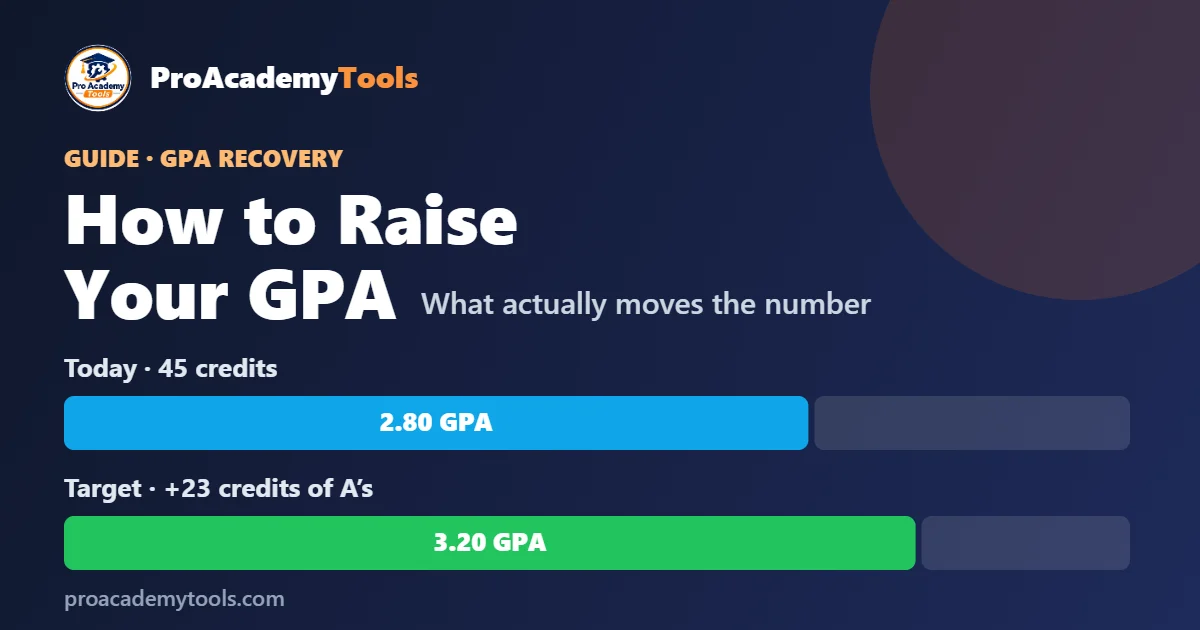
Credits of A’s needed = current credits × (target − current GPA) ÷ (4.0 − target). A student with a 2.8 over 45 credits needs about 23 credits of straight A’s to reach 3.2 — roughly a semester and a half. A more realistic plan is a 3.60 average over the next three semesters, or 3.50 over four.
Two takeaways: act early, because each semester you wait makes the climb steeper, and set a target that matches your credits, not a number that is mathematically out of reach.
Step 2: Use the policy levers (they work faster than studying)
- Retake courses with grade replacement. If your college replaces the old grade (often called grade forgiveness), retaking a D or F removes those quality points entirely — often worth more than a new A. Some colleges average both attempts or limit how many courses you can replace, so read your registrar’s repeat policy.
- Withdraw before the deadline. A “W” usually does not count in your GPA. If you are failing a class and cannot recover — check with the final grade calculator — a withdrawal protects your GPA. Watch out for financial aid and full-time status rules.
- Use pass/fail (credit/no credit) wisely for electives outside your major, within your college’s limits. A pass usually adds credits without affecting GPA.
- Balance your schedule. Pair hard requirements with courses you are strong in, rather than stacking the toughest classes in one term.
- Take summer or winter courses if your college counts them in GPA — a lighter, focused load is easier to ace.
High school student? Your weighted GPA rewards honors and AP classes, but a C in AP can still lower your unweighted GPA. See how both move with the high school GPA calculator, and read our guide to weighted vs unweighted GPA.
Step 3: Raise the grade in each class
- Know exactly where each grade stands. Ask for, or calculate, your category averages with the weighted grade calculator. Assignments worth 30% of the grade deserve more effort than 5% quizzes.
- Use retrieval practice. Testing yourself (flashcards, practice problems, past papers) is one of the two study techniques rated highest for effectiveness in a major review of learning research — the other is spacing.
- Space your study. Several shorter sessions spread over days beat one long session the night before.
- Go to office hours early. Ask about a low grade before the next exam, not after the final.
- Never skip low-stakes points. Homework, participation and attendance points are the easiest marks you will ever earn.
- Plan for finals. Work out what you need on each final and spend your time where the gap is biggest — our guide to what you need on your final shows how.
Can you raise your GPA in one semester?
Yes — if you have few credits. A first-year student with 15 credits at 2.5 can reach 3.25 with a perfect semester. A senior with 90 credits at 2.5 can only reach about 2.71. Seniors should focus on the grades that matter for their next step: major GPA, last-60-credits GPA, or a strong upward trend, which graduate programmes and employers often weigh.
Is a 4.0 still possible?
Only if every grade so far is an A (or replaceable). Once a lower grade is permanently in your record, a 4.0 cumulative GPA is mathematically impossible — though you can get very close. A goal such as 3.7 is usually more useful and still opens most doors.
Frequently asked questions
How fast can I raise my GPA?
It depends on how many credits you have. With 15 credits, one perfect semester can lift a 2.5 to 3.25; with 90 credits it reaches only about 2.71. The GPA raise calculator shows your exact numbers.
Does retaking a class raise your GPA?
Usually, yes. Under grade replacement the new grade replaces the old one in your GPA. Some colleges average the two grades instead, so check your repeat policy before registering.
Does a W affect GPA?
At most colleges a W (withdrawal) appears on your transcript but is not counted in your GPA. Too many withdrawals can affect financial aid and academic progress, so use them sparingly.
Can you go from a 2.0 to a 3.0 GPA?
Yes, but it takes time. With 30 credits at 2.0, you need 30 credits of straight A’s to reach 3.0, or about 60 credits at a 3.5 average.
What GPA do I need next semester to reach my goal?
Use (target × (current credits + new credits) − current GPA × current credits) ÷ new credits. If the result is above 4.0, spread the goal across more semesters.
Sources and methodology
GPA projections use the standard credit-weighted GPA formula on a 4.0 scale, assuming 15 credits per semester. Repeat, withdrawal and pass/fail rules vary by college.
Reviewed by the ProAcademy Tools editorial team. Found an error? Tell us — we correct mistakes quickly.